Saturday, March 14, 2015

"Justice Wasn't Easy"


JUSTICE WASN’T EASY
DECEMBER 2012
When Victor Frolich announced in the spring of 1962 that he was having a contest to rename his recently purchased Soldotna motel, he was doing more than merely stamping his own identity on the place. He was masking a stain from its past.
On Dec. 18, 1961, Arthur Vernon Watson had shot and killed Marion T. Grissom, a former employee who had been assisting in the construction of the Watson Motel.
Watson, 53, never denied shooting Grissom. In fact, he was the one who had called the authorities after Grissom dropped dead on Watson’s kitchen floor. But Watson claimed that he had pulled the trigger in self-defense, and the facts of the case were muddled enough to generate doubt.
One problem was a lack of witnesses. Grissom, after all, was dead. Watson’s 65-year-old wife, Elizabeth, had been on the premises when the killing occurred, but she claimed to remember nothing. Consequently, Watson himself provided the only first-hand testimony.
For members of the public—and for attorneys at the 1962 trial—the decision concerning whom and what to believe seemed to boil down to a matter of character.
Marion Grissom, by all accounts, was a poorly educated, hard-working man who liked to drink. The accounts were more mixed when it came to his behavior while intoxicated. Defense attorney Peter B. Walton described an intoxicated Grissom as a “savage beast” and said that Watson’s fear of this beast played a part in the shooting.
On the other hand, Warren Wright, a former employee at Watson’s motel, testified that Grissom was “playful” when drinking, and his depiction was echoed by Frank Mullen, owner of a local Laundromat, who added that Grissom was “boisterous” when intoxicated. Bar owner Maxine Bear testified that Grissom was “a working man … a happy-go-lucky type of guy … very friendly”; she said she’d never seen him display anger when intoxicated.
But Mrs. Watson, who was originally from San Francisco and had married Watson in Las Vegas in 1959, offered a contrary and more damning view. She testified that Grissom was a strong man who “couldn’t think for himself” and “always had a bottle hid around on the job.” She also recalled an incident from the previous October during which Grissom had brutally mistreated the Watson family dog. Another time, she said, Grissom “started grabbing me and pushing me around.”
She told the court that at the Watson residence she had once witnessed her husband and Grissom fighting for possession of a rifle that Watson had taken up in order to force Grissom from the house; she said the two men had fought to an impasse that time, and Grissom had left.
Meanwhile, the character of Arthur Vernon Watson proved at first more difficult to pin down, partly because of something else his wife said.
According to Watson, he was protecting his wife and himself on the night of the killing. Watson testified—and evidence at the scene indicated—that Grissom and the Watsons were drinking alcohol together on that night. Watson said that at about 6 o’clock that evening he left his wife and Grissom at his home while he went to have his truck fixed. When he returned at 8 p.m., he testified that he discovered his wife lying on the floor with her face bloody, and as he leaned down to pick her up, Grissom assaulted him.
Watson claimed that he and Grissom struggled until he grabbed a knife from the kitchen drainboard and used it to force Grissom to leave the house. When Grissom started to walk away, Watson said, he set the knife down to tend to his wife. Then he heard a noise and spun to see Grissom coming at him again. He picked up a nearby rifle, levered a cartridge into the chamber, pointed the weapon at Grissom, and told him to get out. But Grissom kept advancing, Watson testified, so he shot and killed him.
According to court documents, a state police officer named Morgan testified that Mrs. Watson was in bed when he arrived at the scene of the crime. Officer Morgan said that he and another officer interrogated Watson for approximately two hours before Mrs. Watson emerged from the bedroom. The officers noted that Mrs. Watson had “suffered contusions of the neck, facial cuts, and a blow on the head which caused swelling,” according to an Anchorage Daily Times story from March 9, 1962.
Officer Morgan testified that when Mrs. Watson saw blood on the floor, she asked what it was. When she was told it was blood, she asked, “From what?” When she was informed that Watson had shot Grissom, she exclaimed, “Oh, no!” and then turned to her husband and said, “It’s your temper! Your temper has done it again!”
At trial, the defense attorney argued against the admission of this testimony as evidence, calling it hearsay, but the judge allowed it. During Watson’s later appeal of his conviction for second-degree murder, the Alaska Supreme Court would side with Watson and demand a retrial. According to the written court decision, Mrs. Watson had claimed to have no recollection of the shooting incident, so her uninformed reaction to news of the incident was prejudicial, especially since district attorney James Merbs had failed to elicit from either officer any testimony concerning whether Watson had reacted to his wife’s supposition.
But Watson had other problems during that first trial. Since he and his attorney were attempting to establish that Watson was afraid of Grissom, Mrs. Watson’s testimony concerning their earlier battle over a rifle appeared to contradict that premise.
Watson’s attorney said that, six months before the shooting, Watson had reported to Officer Morgan the incident with the rifle in order to urge Morgan to tell Grissom to stay away from him, especially when Grissom was drinking. During redirect testimony, however, Officer Morgan testified that Watson never came to him with this request; instead, he said, he had gone to Watson after Watson’s former employee, Wright, had complained to the police that Watson had taken a shot at him.
Besides, if Watson was afraid of an intoxicated Grissom, it seemed odd that on the night of Dec. 18, 1961, he had invited Grissom in to drink with him and his wife.
In the end, the jury found Watson guilty, and during the 1964 second trial the verdict once again was guilty of murder in the second degree. However, even that was not the end of the case.
Watson and his attorney appealed again—and for good reason.
On Friday, Nov. 6, 1964—the last day of the trial before the jury was to begin deliberation—several jurors had read a newspaper article that described Mrs. Watson’s disallowed hearsay testimony from the first trial. In a written affidavit, juror Gene R. Jones admitted to seeing the story: “On the afternoon of Nov. 6, 1964, I remember going downstairs in the State Court Building and buying an Anchorage Daily Times from the blind fellow who has the concession stand. I took this newspaper back to the jury assembly room as the jury was out of the courtroom on that date from 2 p.m. to approximately 4 p.m. In this newspaper, I remember reading an item pertaining to the State of Alaska vs. Arthur V. Watson case.”
Because of the jurors’ actions, the Alaska State Supreme Court in April 1966 once again sided with Watson and demanded another new trial.
Meanwhile, Watson was making life tougher on himself. Pending the Supreme Court decision on his appeal from the 1964 retrial, Watson had been released on bail. At some point in early 1965, he slipped out of the state and wound up back in San Francisco. Unfortunately for Watson, his disappearance generated a manhunt and attracted the FBI.
In February 1965, the Associated Press produced a story about the arrest of Arthur Vernon Watson, calling him a “San Francisco ex-convict.” Watson had been about to board an express bus for Southern California when he was nabbed by FBI agents in a crowded Greyhound terminal. Highlights in the brief story included Watson’s murder conviction in Alaska, a note that Watson “had spent a third of his life thus far in prisons throughout the United States,” and mention of his recent firearm-possession arrest in Anchorage.
Although the facts are somewhat unclear beyond his arrest in San Francisco and the Supreme Court’s guilty verdict the following spring, Watson somehow was a free man again in 1976. He was 68 years old and living in Portland, Oregon, when the car in which he was riding struck a parked truck on Interstate 80N just west of The Dalles. The impact killed Watson.
And back in Soldotna, there was also no longer a Watson Motel. Victor Frolich had made sure of that.
In the spring of 1962, after paying $10 to the winner of his name-my-motel contest, Frolich changed his new establishment to the Wye Motel, largely because of its proximity to the Sterling-Spur Highway junction.
Many years later, the motel was sold again, and today—with the criminal connections to Arthur Vernon Watson a half-century in the past—it has been expanded and remodeled and is known as the Soldotna Inn, the companion to Mykel’s Restaurant.
 

"Hunting Whales to Attract Tourists"


From a special section of the Anchorage Daily Times in 1965.
HUNTING WHALES TO ATTRACT TOURISTS

AUGUST 2008

At a time when efforts are afoot to list the Cook Inlet beluga whale under the federal Endangered Species Act, it may seem strange to contemplate that in the early 1960s the Kenai Chamber of Commerce actually sponsored an organization called The Beluga Whale Hunt Club.

The chamber was “looking toward utilization of the beluga whale,” according to James Fisher, a retired Kenai lawyer and the president of the chamber from 1962 to 1964. Consequently, beluga hunting and the subsequent consumption of “beluga burgers” became a featured attraction of the annual Kenai Days celebration from 1963 to 1965.

The December 1963 issue of Alaska Sportsman reported that the whale hunt was “a great idea publicity-wise, but didn’t produce a lot of meat.”

According to the magazine, “Blustery weather kept amateur whale hunters pretty much on the beach, but a previous ‘practice’ hunt provided about 300 pounds of meat” for Kenai Days. Kenai pharmacist John Hulien, who had spearheaded the foundation of the club and referred to himself as the “Chief Whale Wrangler,” reported that “every pound” of the meat (as burgers or in cans) was sold.

The club, ultimately a short-lived attempt to spice up big-game-hunting opportunities and entice tourists to the Kenai area, was organized in the summer of 1963. Membership in the club cost three dollars, and, according to the magazine, new members received a small bottle of whale oil, a chance to participate in the hunt, and “the right to have their names burned into a six-by-six-foot whale hide on display at the city center.”

By May 1964, The Cheechako News reported that efforts were well under way to broaden the abilities and opportunities of the club. Al Munson, the paper said, had donated an “unused gear shack” on the beach below Kenai, area pilot Bud Lofstedt was going to be hired to spot pods of whales from the air, the first crew of Reed Kent and Denny Denbrock were ready to go out, and “practice with the Norwegian harpoon rifle recently acquired has been continuing with increased accuracy by club members.”

Meanwhile, according to the Cheechako, Helen Fisher, club member and wife of the chamber president, had made some experimental whale oil soap, and the club itself was hoping to supply whale oil for the Alaska exhibit at the World’s Fair in New York City. Five gallons of oil and certificates of membership in the club had already been sent, the paper said.

Nancy Lord, author of the 2004 nonfiction Beluga Days, interviewed former Kenai resident Lance Petersen, who had written an informational booklet for the club. A long-time peninsula teacher, Petersen remembered that the club had used his family’s winch truck to raise harvested belugas out of the water at Arness Dock and haul them into town.

Petersen, who still had his club membership certificate and souvenir bottle of oil, recalled the barbecue fondly and the meat as red and flavorful.

Lord also referred to a 1965 Cook Inlet Courier article, which said that Hulien and whale guide Ken Tapp took a couple of army men out for 10 hours of hunting over two days. “They fired 250 rounds of ammunition and ended up with zero belugas,” Lord wrote.

Tapp, whom Lord tracked down to his current home in Oklahoma, said that he had shot “maybe 25 to 30” belugas, but he was unconcerned about the numbers. “There were thousands of those doggone things,” he said.

Tapp’s assessment of the beluga population was in dispute even then, however, and in 1972 the Marine Mammal Protection Act banned all sport and commercial harvest of such animals. According to a 2000 Marine Fisheries Review article by Barbara A. Mahoney and Kim E.W. Shelden,  there were at least 1,300 belugas in Cook Inlet in the 1970s but the numbers have been falling ever since.

The National Oceanic and Atmospheric Administration fisheries department estimated the 2006 Cook Inlet population at 302 and said that a 50-percent decline occurred from 1994 to 1999.

Ultimately, despite much fanfare from Hulien—described by Fisher as “kind of outgoing and substantially involved in the Kenai community”—the club’s activities and its participation in Kenai Days disappeared after 1965.

Still, Hulien didn’t go down without a fight, as shown by an enthusiastic advertisement for guided beluga hunts published in an outdoor section of the Anchorage Daily Times on July 1, 1965.

The ad, entitled “Beluga Offer Top Big Game,” gushed that “several Alaskan guides have said that hunting the beluga whale is by far the most exciting big game hunting ever done.”

The hunt, the ad continued, “begins at sea in an open dory about 20 feet long.” The dory crew would maneuver into a pod of whales and attempt to separate one from the group. Then, “the dory rides herd on it and edges it toward shallow water.”

The actual kill was described this way: “After an hour or more of tracking, with more than 100 rounds of ammunition spent, the whale is usually fatigued enough to allow the dory to come within harpoon-throwing distance. Hardier hunters use the 10.15mm Norwegian harpoon rifle, as it really packs a punch.”

POSTSCRIPT FROM 2011

A blog of the American Cetacean Society added these thoughts in a posting entitled “Beluga Whales: Food for Thought”: “Helen Peters [was] reminded her of the years she spent in Kenai back in the late ‘50s and early ‘60s when she worked as a public health nurse. She said that John Hulian, the local pharmacist, founded the Beluga Whale Hunt Club in 1962 as a means to raise funds for the Kenai Chamber of Commerce during the Kenai Days celebration. … The club was disbanded in 1965 but during the three years that it operated, the beluga-burgers, which sold for a dollar apiece, were the highlight of the event. Helen described how every year she would buy new garbage cans that she used to marinate the meat in vinegar and spices, then grilled the meat to perfection over an open fire and served it on a bun. She said that the biggest obstacle to getting people to buy them wasn’t the taste (which she described as similar to beef or buffalo); it was the color of the meat (which was almost black) that she remembered so vividly and found so off-putting.”


"Life of Perpetual Motion"


Charlie MacInnes, in his mid-60s, ready for another long bike trek.
LIFE OF PERPETUAL MOTION

JULY 2012

It was difficult not to be impressed by the physical abilities of Charlie MacInnes.

In December 1979, for his Christmas vacation, he spent nearly two weeks bicycling 1,116 miles from San Diego, California, to Cabo San Lucas at the southern tip of the Baja peninsula in Mexico.

On the first day of this trip, he was nudged off his bike in San Diego traffic by the box of a camper truck driven—as MacInnes wrote later in his diary—by “an overweight American tourist.” Despite abrasions to his left elbow and right leg, he climbed right back on his bike, determined not to allow a bad beginning to ruin his entire vacation.

MacInnes was 66 years old at the time.

In his mid-60s, Charlie MacInnes was a lean machine. After the effort of the Baja bike tour, he weighed only 137 pounds (down about 10 pounds from his usual weight), and stood 5-foot-9½ in his bare feet. In a photo accompanying a January 1980 Cheechako News article about the bike trip, MacInnes is seen standing next to his touring bike and facing the photographer. Evident even in grainy black-and-white is his squarish, handsome face, coupled with his wiry arms, tapered chest, thin waist, and muscular legs—a chiseled form atypical for a man his age.

But that strong frame was no fluke of genetics. It had been carved through the hard work of a lifetime on the move, years of self-propulsion by a man who eschewed most mechanized traveled in favor of whatever distance he could cover under his own power.

MacInnes, and his wife, Kit, preferred to glide on skis, run on their own two feet, mush sled dogs, and ride bicycles—and so that’s what they did, decade after decade. Starting in their 20s, they ventured outdoors and began moving forward, producing some striking results:

Kit MacInnes competes in a sled dog race in 1955.
·         They both competed in the dogsledding sprint races at Fur Rendezvous and elsewhere from the late 1940s until the early 1960s. In 1961, at the age of 42, Kit won the Women’s Championship for the third time. Charlie won a number of preliminary events and finished high in the finals many times.

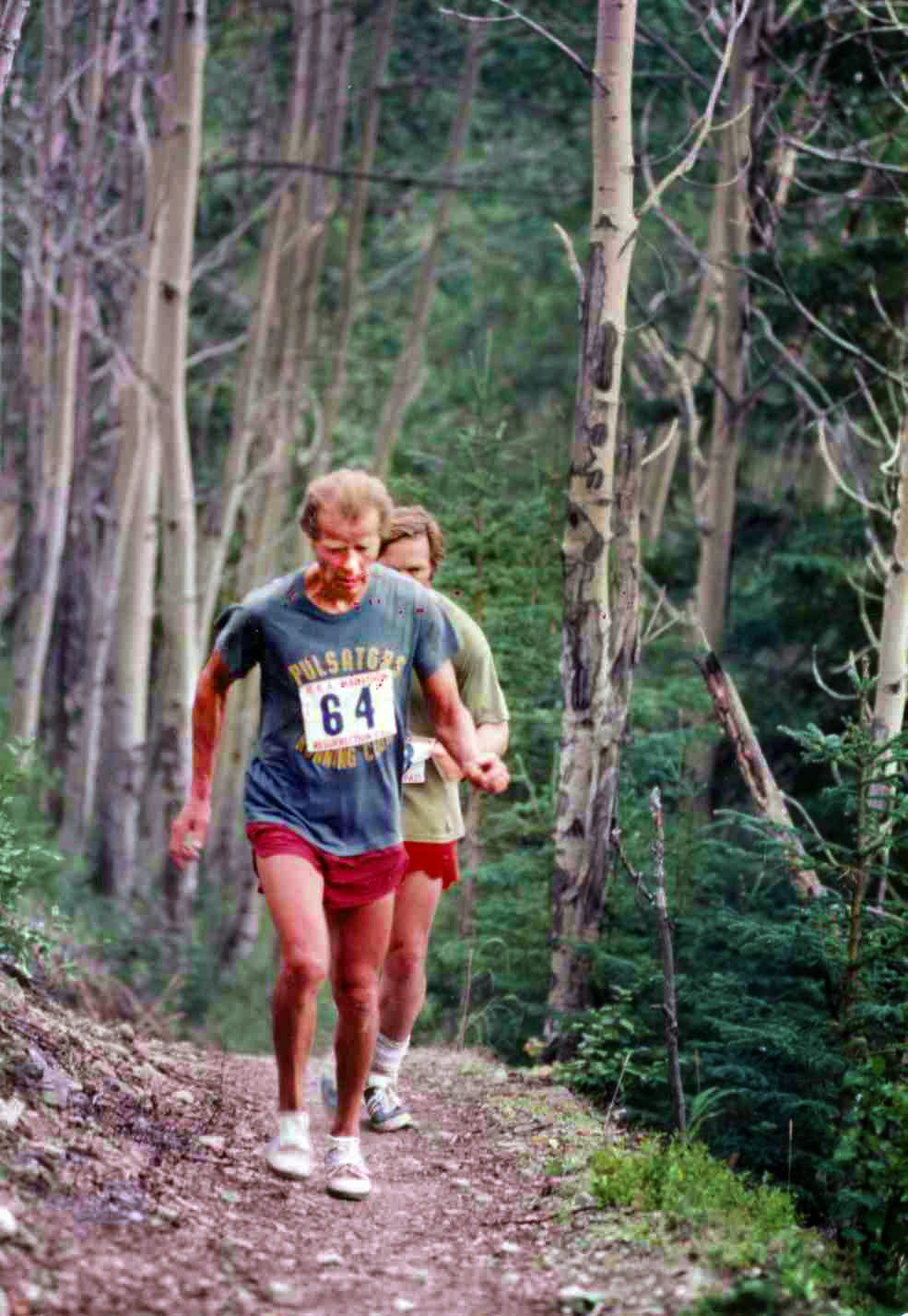
·         Charlie, at the age of 64 in 1977, competed in a marathon on the Resurrection Pass Trail.

·         In her late 60s, Kit, petite and only five feet tall, was still competing in races with her daughter, Ann (MacInnes) Mize.

·         In his early 70s, Charlie once rode his bike from their home on Mackey Lake Road to the end of the spit in Homer, intending to ride back far enough to earn a “century”—a 100-mile day—before calling to have someone drive down and pick him up. Instead, he felt so good that day that he decided to ride on home. Upon his arrival, he determined that he was close to a “double-century,” so he kept going. He headed north and then doubled back to earn his total.

·         Both Charlie and Kit stayed physically active into their early 80s.

According to the MacInneses’ good friend, Alan Boraas, all this fitness, particularly during their geriatric years, ran counter to the medical wisdom that prevailed when Charlie and Kit were growing up and even in their early adulthood.

“At the time, the wisdom was that you stopped doing sports in your teens or early 20s,” Boraas said. “(After that) it wasn’t seemly to be running. Doctors felt it was a stress on the heart. And both Charlie and Kit were of the opinion, contrary to what medicine said, that they loved (vigorous exercise), and it was meaningful to them.”

“I don’t think Charlie or Kit ever even considered the thought that getting older meant that they could do less,” Boraas said. “And Charlie was certainly aware that he didn’t have the stamina that he did when he was younger—Kit, too, probably. He was aware that he wasn’t as fast—but that didn’t matter. He thought, ‘What’s the percent of my ability that I can do?’ And so they always pushed to the 90 percent of whatever age they were. And they had great admiration for those that did the same at their age.”

 “It was the body that was important,” Boraas continued. “It was what the body could do. And that’s a fact that a lot of people miss today. Well, for Charlie and Kit exercise was a joy. It was the meaning of life. And so the body was a vehicle for the two of them to embrace that life. And that’s the significance. They didn’t sculpt their bodies to look good. They created hard, muscular, endurance-based bodies in order to enjoy those endurance activities that they loved.”
Ski touring with their dogs in Turnagain Pass in 1992.


It was that mindset and that endurance-based body that allowed Charlie (as part of a 20-person guided group of mixed ages) to pedal more than 1,100 miles through dry desert country in his mid-60s—an average of about 10 hours and 80 miles of pedaling per day, sometimes over mountainous terrain, for a dozen days. In his trip diary, he wrote that their guide had told him that Charlie was the oldest biker ever to complete the trip.
Charlie and Kit mountain biking in 1989.

In 1994, less than a year before Charlie died, Boraas recalled, he and Kit were still active outdoors—still biking, still skiing. On one particular day that Boraas and his wife were skiing at Kincaid Park in Anchorage, they unexpectedly met up with Kit and Charlie (then about 80 years old) on the trails:

“We saw two old people shuffling up the trail. It was, of course, Charlie and Kit MacInnes. It was near the end of the day, and we talked happily about racers, skiing, trails and weather, all the while bathed in the wonderful yellow light that comes with the setting sun in mid-winter,” Boraas wrote about the incident.

“Then Charlie said they better be going, and Kit said, with a twinkle in her eye, “Race you to the car.” Cheeks red, eyes merry, the two old folks stepped around to gain the advantage on the trail. Charlie got going first. But Kit stuck out her pole and tripped him and then zipped into the lead. The chase was on. We could still hear them laughing as they rounded a bend and disappeared from sight. It may have been the most spirited race of the day.”

HOW IT ALL BEGAN

When they first arrived in Anchorage from Pennsylvania in 1946, Charlie and Kit lived inside a large packing crate in the Mountain View area. Charlie constructed a wooden yoke for Kit so that she could carry two buckets and haul fresh water to their home each day.

Such living wasn’t easy, but fortunately for the MacInneses their situation quickly improved.

Soon, they were in the undeveloped Tudor Road area, building their first house together on a wooded 20-acre homesite. Their new place, a wood-frame, two-story building with a chimney and fireplace handmade from boulders hauled in from distant Granite Creek, would be their home for nearly the next 30 years.

There—before moving to the Kenai Peninsula for their retirement years—they would raise their daughter, Ann, and son, Scott, and firmly entrench themselves in the outdoor-based, active lifestyle that would become their trademark.
Charlie in Navy uniform, 1941.

Charles Ernest MacInnes was born in 1913 and raised in Philadelphia. He attended college to earn a business degree, and he entered the Navy in 1941, serving until just after the end of World War II. Catherine (“Kit”) Chambers MacInnes was born in 1919 and also raised in Philadelphia. She, too, attended college, earning a degree in physical therapy.

Charlie and Kit, who were still enjoying running and other outdoor activities in their 20s, well after many of their contemporaries were settling into more sedentary lifestyles, married in 1946 and headed for a honeymoon in Alaska, fulfilling a long-held dream of Charlie’s to visit the north country.

They never looked back.

In Anchorage, Charlie found employment behind the ticket counter at Pacific Northern Airlines. PNA would eventually merge with Western Airlines, which would later merge with Delta Airlines, and during all that time Charlie would work behind the counter, despite having the intellect and the acumen to enter into a management position, according to Boraas.

“He specifically chose that job for two reasons,” Boraas said. “It was a 9-to-5 job. He did not want a job that he could take home with him, where he could lie awake at night worrying about whatever. He wanted a job that allowed him freedom to have the active outdoor lifestyle he embraced. And because he worked for an airline, he got essentially free travel. He loved to travel, and travel usually involved some sort of exercise, bicycling or skiing or whatever.”

Charlie running a marathon on Resurrection Pass
Trail in the summer of 1977.
While others might have succumbed to the social pressures to keep climbing a ladder of success, Charlie remained content. He worked for the airline until his retirement in 1975.

Meanwhile, Kit put her physical therapy degree to use, becoming the first P.T. ever hired by the original Alaska Native Medical Center. Like Charlie, she rarely carried her work home with her, allowing the growing MacInnes family time and energy to ski, run, bike, mush sled dogs, and hunt together. She retired a few years earlier than Charlie, and was ready for their big move to the peninsula when it came.

Kit cross country skiing in 1988.
Before they moved out of town, however, the MacInneses firmly entrenched themselves as pioneers in a growing Anchorage community of outdoor enthusiasts. They alpine skied in the mountains, mushed dogs in the Fur Rendezvous sprint races and in other races around the state, biked along the road systems, and skied and ran cross-country for fun and competition.

The year Charlie retired, they purchased a parcel of land just off Mackey Lake Road in Soldotna, and they left Anchorage behind. On their new property, they initially settled for a small cabin and a large outbuilding for their canoes and skis, their other outdoor gear, and the requirements for their livestock and pets—mainly horses, chickens, and dogs.

Boraas, an outdoor enthusiast who had arrived on the peninsula only a few years earlier, first encountered the pair at a meeting of the Kalifonsky Nordic Ski Club.

“They both had a huge impact on me, reaffirming what we were all trying to do,” Boraas said.

From their Soldotna home, the MacInneses continued to travel and to embrace vigorous outdoor exercise. In his 60s, Charlie began making his long bicycling treks, once traveling to the Texas coast to do some birding.

Often, Boraas said, Charlie would write about his trips after he had completed them, and his writing revealed both his environmental ethos and his careful eye for detail. On the Baja trip he wrote:

“I sat by my cheery fire and thought of my wife this Christmas Eve. There was a fat waxing sickle moon in the zenith whose silvery light made facile moving about my tiny camp. I leave only a few boot prints. No debris to defile Mother Earth.”

On Dec. 28 in Cabo San Lucas, the end point of the trek, he made the following entry:

Charlie, 1987.
“The climax of the trip was quite colorful. The paved road made a left turn in the middle of the small town. There, just beyond the plaza, were about 20 touring bikes all parked along a stone wall on the sidewalk, colorful with the rainbow assortment of numerous bike banners. Twenty cyclists sat on the curb, busy quaffing pop, eating fruit and cookies, and talking. I think everyone reveled in a deep sense of accomplishment.”

Kit and Charlie were also integral to the growing outdoor-recreation scene on the central peninsula. They could be seen running and biking and skiing throughout each year, and they were involved in the early stages of the Tsalteshi Trails.

Kit, 1984.
Of his father—and, by extension, his mother—Scott MacInnes said, “He just enjoyed staying active. And he was determined to stay active. It was just part of his lifestyle.”

After a brief bout with cancer, Charlie passed away in 1995 at the age of 81. Kit, who suffered a stroke several years later, died in 2003 at the age of 83.

About a week before he died, Charlie was still on his bicycle. He came home from his last ride, Scott said, and told the family that he didn’t feel well.

During that ride, or one about that same time, Charlie was pedaling along the flats beyond Sterling when Boraas drove by: “I was going to Seward, or to Anchorage, and there was Charlie on his bike. And his bike wheel was going so slow that he was barely moving, but he was out there. He kept going till the end—I just wanted to stop and give him a hug, but, you know—that’s the significance of Charlie.”


"Losing the Battle to Save an Old Cabin"


This photo, reportedly from 1943, shows the Manitoba cabin in the foreground and the Michaelson cabin in the background. The pile of timbers next to the Manitoba cabin belonged to structure that Willard Dunham said was used to unite the two structures that form the Manitoba cabin in this picture. All photos, unless otherwise noted, are courtesy of Theresa Zimmerman.

LOSING THE BATTLE TO SAVE AN OLD CABIN

NOVEMBER 2012

Willard Dunham answered the phone, listened for a few moments, and immediately boiled over.

It was the early 1970s, and he was working as a longshoreman in Seward when he received a phone call from a gold miner named Ron Newcome, who operated several claims on Canyon Creek near a cabin that Dunham’s family had owned since the early 1940s. Newcome wanted to alert Dunham to the movements of a U.S. Forest Service crew that was planning to destroy Dunham’s cabin.

Delbert and Lenore Robbins (mother of Willard Dunham) do a little cross-
country skiing, probably in the vicinity of the Mills Creek drainage.
It wasn’t the first time that the Forest Service had threatened the existence of the cabin, and it wouldn’t be the last. But on this particular occasion, Dunham was determined to meet the threat head on and deal eyeball to eyeball with the federal agents to whom he referred frequently as “bastards” and “sons o’ bitches.” He climbed immediately into his vehicle and sped down the Seward Highway toward his property beyond the northern end of Lower Summit Lake nearly 50 miles away.

Newcome had explained that “a so-called team of experts out of Anchorage” had approached the Dunham place—located near the southwestern base of Mount Manitoba, just north of the confluence of Mills, Fresno and Canyon creeks—and dug a hole to test the validity of the minerals claim attached to the property. Finding no “color” at their test site, the experts had affixed to a nearby tree a yellow tag reading: AREA CLOSED TO MINING. NO MINERAL CONTENT FOUND.

According to Dunham, he arrived just in time to confront these experts as they prepared to ignite his place.

“I told ‘em, ‘Yeah, that’s fine,’ and I took pictures of ‘em. And I said, ‘When you do it, I’ve got it insured, so I’ll turn you in for arson.’ (The man in charge) looked at me and said, ‘Well, you can’t do this,’ and I said, ‘Watch me.’ And then they bundled up all of their stuff and left.”

Dunham hadn’t been bluffing. The cabin was insured. He said that at that point the Forest Service had been trying to destroy all the buildings on the property for 30 years, and buying insurance had been a recent safeguard against government interference. Many years earlier, Forest Service agents had burned down an abandoned mining cabin—one of the oldest—on the same property, and Dunham said that they had been destroying old mining relics throughout the Chugach National Forest.

“Then Newcome took me up and showed me the so-called test hole they’d dug, and it was in the middle of the goddamned highway,” Dunham said. He was referring to a remnant of the old Seward-Hope Highway, part of a connecting route to the historic Iditarod Trail that began in Seward. The road bed for that old highway sat well above gold-bearing Mills Creek, and Dunham said that a test hole dug down by the creek itself would have yielded plenty of mineral content.

“I still get upset when I think about all the crap the Forest Service pulled,” Dunham said. “My dad said, ‘Those bastards like the Forest Service, you have to train them because they couldn’t possibly be born that way.’”

Shortly after his confrontation with the team of experts, Dunham and his wife, Beverly, decided to sell the property. “I got tired of fighting with them,” Willard said.

“We sold it to a young couple (Whitey and Mickey Van Deusen),” said Beverly, “and I told them, ‘You’re probably not going to be able to keep the cabin. They’re probably going to succeed in getting rid of it at some point.’”

Although the Van Deusens were eventually challenged by the feds, their initial troubles with the place were of a much more personal nature. “The woman was having her first baby,” Beverly said. “They were going to have it out there (at the cabin). They were going to deliver it. They were going to do all of it themselves. And I told her, ‘I don’t think this is a good idea. Since this is your first baby, you don’t have any idea what this is going to be like. And what if something goes wrong?’ ‘Oh, no, no,’ they said. ‘Everything’s going to be just fine. We’re going to do just great.’

“And so what happened? Things did not go well at all—and they had to snowshoe out (to the highway). And she’s snowshoeing out in labor. And it turned out the baby was breach, and chances are they would have never been able to do what was needed done correctly. And she got to Anchorage just in time before something serious happened.”

The Van Deusens later sold out and moved to Seward, where they started a bus service for tourists, Beverly said, and Mickey used to enjoy telling the story of her pregnancy to their aghast clientele.

Meanwhile, the property moved into the hands of Ted and Ruth McHenry.

According to Mary Barry in her book, A History of Mining on the Kenai Peninsula, Alaska, Ted McHenry “was a state fish biologist, outdoorsman and occasional miner” who became the new owner of the Manitoba Cabin and its adjoining claims. Barry says that the Forest Service quickly “started procedures” to wrest control of the cabin away from the McHenrys.

The Forest Service contended that McHenry had not proven “the validity of his claim regarding its mineral content.” McHenry protested. The Forest Service fought back. The case went to court and bounced to higher and higher authorities. And by the late 1970s, the McHenrys had lost.

Since the McHenrys had not removed the cabin from the property, the court awarded control of the structure to the Forest Service, which did not destroy it after all. Instead, the agency decided to lease the cabin and its remaining outbuildings to the Nordic Skiing Association of Anchorage. And for nearly two decades, the denizens of cross-country and telemark skiing employed a special permit to keep the cabin standing.

Thus, its future, while always somewhat shaky—much like the cabin’s sagging foundation—seemed assured.

Meanwhile, its past seemed shrouded in mystery and missing records. It was a past that included one of the richest payloads of gold on the entire Kenai Peninsula, a most remarkable woman named Polly, and a debate concerning whether the Manitoba Cabin had ever truly been a link in the transportation chain responsible for the delivery of the U.S. mail.

PEERING DEEPER INTO THE PAST

The Manitoba cabin was already well entrenched in the family history by the time Willard and Beverly Dunham—away from the presence of their disapproving parents—got married in Fairbanks in 1951.

While Beverly was in college in Oregon, she had received a wire from Willard in Fairbanks to tell her that he had just won $2,000 playing craps, and he wanted her to head north and get hitched. So she quit school and flew to Fairbanks to say her vows. “Our families,” said Beverly, “were not pleased at all.”

According to Willard Dunham, one-time owner
of the Manitoba cabin, seen here are Jack and
Marie Shield, who lived in the Manitoba cabin
in the late 1930s. The Shields are standing in
front of the old entryway to the cabin.
Fortunately, Willard’s parents—mother Violet Lenore (Dunham) Robbins and step-father Delbert Robbins—were not so displeased with Willard that they were willing to disown him. When the Robbinses, who had purchased the Manitoba cabin in 1942 from Jack and Marie Shield, decided after statehood to leave Alaska, they deeded the cabin and adjoining property in 1961 over to Willard and Beverly for a dollar.

The Dunhams said they kept the property in the family for another decade before they wearied of Forest Service efforts to destroy the place, which they considered an important link to the area’s long mining history.

The validity of that “link,” however, has long been a source of controversy.

The mining history of the area begins with a confluence of gold-bearing creeks and what came to be known as the Cook Inlet Gold Rush. East of the rocky promontory upon which sits the Manitoba cabin, Juneau and Mills creeks unite to travel westward into Fresno Creek to form Canyon Creek, which then tumbles through a jagged gorge before descending northward toward Sixmile Creek near the Hope Road. All of these creeks began receiving heavy mining pressure in about 1895.

According to Mary Barry, Mills Creek was named for Sanford J. Mills, who acted as recorder for the Sunrise District and had planned to locate gold claims on the stream named for him. After he changed his mind and abandoned his claim in July 1895, opportunities arose for mining partners Robert Michaelson and John Renner, who journeyed to Mills Creek and found coarse gold.

Oscar Dahl’s hydraulic mining operation along upper Canyon Creek,
circa the 1930s.
In August 1895, Michaelson and Renner formed a partnership with three other miners, claimed all of the Mills Creek mineral rights from its confluence with Juneau Creek to its confluence with Fresno Creek, and called their enterprise the Polly Mining Company, after Renner’s remarkable wife.

Born Parascovia Kalashnikoff in 1866, according to Kaylene Johnson in her book Trails Across Time, “Polly” was the daughter of a Russian father and an Athabaskan mother. In the late 1880s, she married Phenice Shell and gave birth in 1890 to a son they named Lewis. Polly became a widow shortly thereafter when Phenice was killed in an accident. Then, in the same year that Renner and Michaelson discovered gold on Mills Creek, Renner discovered and married Polly.

In gold country, Polly simply refused to be a cabin-bound wife. Instead, she picked up a shovel and worked side by side with her husband. At the same time, however, she displayed a keen fashion sense and used her prodigious skills as a seamstress to create her own elegant clothing. And she could easily afford such fineries because the Polly Mining Company struck it rich. The partners pulled $40,000 in gold (more than $1 million by 2012 standards) out of their claims in just the first year.

Soon, Michaelson and Renner bought out their partners, and their mining fortunes continued. According to USGS reports filed in 1905 and 1906 by geologist Fred Howard Moffitt, the most important gold-bearing gravels of Mills Creek were in a narrow canyon three-quarters of a mile above its confluence with Canyon Creek, but there was also plenty of gold to be found, he said, “on top of a blue clay” near the mouth of Juneau Creek.

Handwriting on two of the oldest known photographs of the Manitoba cabin refers to a “Blue Gulch Cabin,” and Mary Barry mentions the name Blue Gulch when discussing Mills Creek mining. However, it is likely that the Manitoba cabin and the “Blue Gulch cabin” are not the same structure. The Blue Gulch cabin almost certainly belonged to Michaelson. The Manitoba cabin almost certainly did not.

This photo, purportedly also taken in 1943, shows the Manitoba
cabin in the foreground and Michaelson cabin in the background.
The photographs themselves—one taken in summer, one in winter, both from the same vantage point, purportedly in 1943—account for much of the confusion. Prominent in the foreground is the Manitoba cabin, but clearly visible in the background is the Michaelson cabin, according to Willard Dunham.

Back around the turn of the century, Renner and a miner named Louis Lauritsen constructed homes near the Fresno Creek confluence, south of Mills Creek, while Michaelson built himself a place to the north of Mills Creek, probably on or near the high rocky promontory.

The revised edition of Mary Barry’s mining-history book features a 1910 map of area mining cabins and mine locations. The only structure shown immediately north of Mills Creek is called the Michaelson cabin. The only structures shown immediately south of Michaelson’s place are called the Renner and Lauritsen cabins.

When Willard Dunham’s parents bought the Manitoba cabin, another structure nearby was called “the Michaelson cabin,” Willard said, but almost certainly all the early structures there—including outbuildings and outhouses, a miner’s dormitory and at least one ore-testing shed, a blacksmith shop and a meat house—belonged to Michaelson himself or to the Polly Mining Company in general.

But it is also possible that one or more of the buildings in existence at that time belonged to Jack and Marie Shield. Willard Dunham said that Shield had used material from an older structure on the property to join together two other buildings and create what became known as the Manitoba cabin. Willard said he remembers being told that one of the buildings involved in the lumber scavenging had been the old miners’ dormitory.

In 1933, the Shields, along with a man named Judge H. Mellon, obtained the Sweepstake Mining Claim via a deed from miner and Seward hotel proprietor Oscar Dahl. According to a 2007 Forest Service document, Dahl’s claim was located “on Canyon Creek just above Mills Creek” and lay “south of Robert Michaelson’s Blue Gulch ditch.”

This description could be somewhat confusing, unless the ditch location refers to Michaelson’s cabin site instead of the Blue Gulch clays. Most of Dahl’s hydraulic mining efforts occurred on Canyon Creek, just north of the Mills-Fresno confluence. In fact, the large gravel pit along the Seward Highway and north of the Manitoba cabin is mostly the rearranged rocks and soil from the powerful blasts of water that Dahl used to scour the creek banks for gold. Also, the phrase “just above Mills Creek” could refer to elevation, not a location upstream, since the cabin site lay high above the confluence.

Lenore Robbins, mother of Willard Dunham, holds her bird dog, Judy, near the front porch of
her family’s cabin by Mount Manitoba in the 1940s. Behind Robbins is the bolt-action.22-
caliber rifle she had recently used to kill the ptarmigan lying on the roof at upper right.
The Forest Service document also refers to an interview with Moose Pass resident Ed Estes—a cousin of Willard Dunham—who claimed that the Manitoba cabin was built in the late 1930s by a man named Ray Thurston. A bill of sale, says the report, places the construction year as 1936.

A 1938 Forest Service report mentions that Jack Shield was mining on his claim at this time. The following year, according to the annual territorial filing report, Shield had been joined on the claim by Delbert Robbins, the step-father of Willard Dunham. Then on May 8, 1942, a conditional bill of sale called for the transfer of the Manitoba cabin to the Robbinses once the full price of $500 had been paid to the Shields.

Delbert and Lenore Robbins put down $100 and agreed to pay the rest in increments of $50 a month, plus seven percent interest.

Later that same year, Gentry Schuster, owner and operator of a recently completed Glacier Ski Lodge on Mount Manitoba, created a map of the area and included the “Manitoba cabin” at its current location.

In 1943, when the final payment had been made on the cabin, Jack and Marie Shield filed a quit claim deed that transferred the property to the Robbinses, who continued mining on the property through 1949, according to the Forest Service.

Their mining activity beyond that is unclear, but by the time they deeded the property over to the Dunhams in 1961, the phrase “Sweepstake Claim” had disappeared from the records. And the apparent absence of continual mining activity associated with the property seemed to have opened the door to the eventual federal takeover of the cabin.

THE CABIN’S ODD HISTORY … AND ITS FUTURE

A nearly forgotten chapter in the history of the Manitoba cabin concerns its startling brief ownership by Dr. Steven Harris.

On Jan. 21, 1976, the Manitoba cabin—part of claims A, B and C of what by then had become known as the Good Rock Claims—were conveyed to Dr. Harris by owners Michael “Whitey” and Patricia “Mickey” Van Deusen. Shortly thereafter, Harris was contacted by U.S. Forest Service officials who wanted him to know of pending class-action legal proceedings against the property.

About three years earlier, Wesley Moulton of the U.S. Dept. of the Interior had performed a “geological examination” of the claims in question in order to determine their mineral potential. Although former owner Willard Dunham had disputed the authenticity of the examination, Moulton’s findings were accepted by his agency.

Moulton wrote: “There have been several prospectors but no mining activity since prior to World War II. [This contradicts the Forest Service observation that Dunham’s parents had been mining on the property between 1943 and 1949.] The present claimants [the Dunhams] are not miners and at the time of the examination did not even have gold pans or sluice boxes. There is no evidence of new prospecting, and it appears the claims are not being used for mining.”

From the snowy yard near her cabin, Lenore Robbins looks out over
Mills Creek and several nearby mining cabins.
Moulton’s assessment initiated a process of deeming the area “mineral withdrawn.” Since Forest Service regulations stated that no mining could occur in such an area, any mining claims there could be voided. Just as the feds were about to void the Good Rock Claims, however, the Dunhams put the property up for sale, and the Forest Service postponed action until a new owner took over.

That new owner was the Van Deusens, who paid the Dunhams $1,750 for the property in a sale in September 1973. Almost immediately, Whitey Van Deusen filed the proper labor notices for mining operations with the Bureau of Land Management, and so the Forest Service was forced to wait again … until Dr. Harris bought the place in 1976.

Understandably, Harris wanted to avoid legal problems with the federal government. He announced that, although he wanted to continue to own the land, he was willing to transfer his mineral rights to the Forest Service.

One month later, before completing that transfer, Dr. Harris was dead.

The Forest Service, in its 2007 report authored by archaeologist Shannon Huber and entitled “Determination of Eligibility, Manitoba Cabin,” does not specify the cause of Harris’s death, but does go into some detail concerning the fate of the property.

In February, Harris’s wife announced that she planned to fulfill her husband’s wishes concerning the mineral rights for the Manitoba cabin property, but she also stated that she wished to donate ownership of the cabin itself to the Resurrection Bay Historical Society in Seward. The Forest Service then decided to wait until the estate was settled before taking further action.

But the property did not go to the historical society. Instead, Mrs. Harris sold it in December 1976 to Edward “Ted” and Ruth McHenry. The following summer, the McHenrys corresponded with the State Historic Preservation Office regarding the historic value of the cabin. The SHPO began but failed to complete an assessment of that value for possible inclusion in the National Register of Historic Places.

Meanwhile, the Forest Service reinitiated its legal proceedings, this time versus the McHenrys, and based upon Moulton’s 1973 “mineral withdrawn” assessment. In 1978, after a nearly two-year legal battle with the McHenrys, the Forest Service gained official ownership of the cabin.

But the agency—despite its threats, its past actions, and the deteriorating condition of the cabin itself—did not destroy the structure.

Instead, the Forest Service began work on an agreement with the Nordic Ski Club of Anchorage to create a non-profit special-use permit for the club to use the cabin recreationally. The 20-year permit was finalized and issued in 1982 and stayed in place until it was terminated on Dec. 31, 2001, because the agency perceived serious safety concerns, despite numerous repairs and renovations by the club over the years.

Those renovations and repairs included additional rafters, a lean-to, a new ladder to the upstairs, improved roofing materials, and a new window. A work room had been torn down to create a bunk room. A new foundation, floor, roof and entrance had been added to the main cabin. The woodshed and the outhouse had been repaired and altered.

Despite improvements, however, Seward District Ranger Duane Harp reported in 1991 that the buildings on the property “can no longer be safely inhabited without incurring excessive liability.”

SHPO representative Veronica Gilbert agreed: “I concur with your proposal to remove the structure as soon as possible due to its deteriorating condition.”

Instead of destruction, however, the cabin received more repairs, and ski club use continued until the special-use permit ran out.

Meanwhile, the debate continued over the historic importance of the Manitoba cabin. Although the Forest Service argued that the cabin was and always had been primarily for recreation, the Dunhams and others continued to dispute those claims.

The main Michaelson cabin, which an ill and nearly blind Michaelson had abandoned in 1930, had been burned to the ground by the Forest Service many years earlier.

Dunham also said—assertions supported by the writings of mining historian Mary Barry—that two of his cousins (Bill and Ed Estes of Moose Pass), who hauled both freight and mail, used to spend the night during their travels in the Michaelson cabin when the miner was still living in the territory and then in the Manitoba cabin in the 1930s when it was owned by Jack and Marie Shield.

The Forest Service stance, however, did not jibe with Dunham’s sense of the structure’s importance.

During the years of the special-use permit, and since, official attempts have been made to assess the historic value of the Manitoba cabin. The most recent, and the most thorough, is the Huber report, which appears to set the matter to rest.

Huber stated that over the years, the numerous repairs, alterations and additions by the owners and users of the Manitoba cabin—while obviously allowing the cabin to continue its useful existence—had actually decreased the structure’s historical integrity.

The well-preserved Lauritsen cabin in the early 21st century.
Ironically—even if the cabin could now be shown to have any inherent historic value—the importance of the Manitoba cabin had been diminished by efforts to improve and save it.

From the National Register of Historic Places evaluation: “Historic cabins associated with productive mining prospects should be evaluated in terms of their overall importance to the mining industry of the region in which they are located—if they are to retain sufficient integrity to visually convey their importance. The Manitoba cabin was used as a modest recreational cabin constructed in the mid-1930s. This cabin is near the historic Robert Michaelson Blue Gulch claim and the well-preserved National Register-listed Lauritsen Cabin, although not associated with them. The Manitoba cabin is linked with the post-gold rush period, not the original rush of the early days. The ownership of the cabin has passed through many hands since the construction of the structure. Over the years, Nordic Ski Club recreational use, past and present mining, and general erosion have obliterated the archaeological record.”


Friday, March 13, 2015

"Criminal Mastermind? Not Hardly"


CRIMINAL MASTERMIND? NOT HARDLY

SEPTEMBER 2011

Editor’s note: I have not yet unearthed the details of the resolution to this 47-year-old story, but enough details of the actual event were available to provide for an entertaining narrative. Also, although I have a photograph that I BELIEVE is of the main character in this tale, I will not publish it unless I can be sure.

The union of the name “Ronald Louis Anthony” and the phrase “criminal mastermind” is unlikely. Anthony himself made certain of that in May 1968 when his own poor planning caused the initial good fortune of his criminal enterprise to rapidly run awry.

Anthony’s target was the cash available in Nikiski at the Mallard Park Branch of Alaska State Bank. The money must have seemed like a reasonably easy target since the bank was located in a 12-by-60-foot trailer house in the Mallard Trailer Park about 9.5 miles north of Kenai.  (Work on the new building that would eventually house the Mallard Park Branch was slated to begin later that summer.)

Despite the seeming “sitting duck” nature of the bank branch, Mary Susan Roberts, who was interviewed by Alaska State Troopers shortly after the robbery, said that Anthony “seemed very nervous” during the process of his crime. It turns out that he had plenty of reasons to be on edge.

Wearing wrap-around sunglasses and white coveralls trimmed in red, Anthony drove a borrowed cream-colored Volkswagen Beetle to the trailer park. Inside the bank, according to archived documents released by the Alaska Department of Public Safety, he went immediately into action. (The date was May 23. The time was 1:45 p.m.)

“I noticed this man come in because he turned to me and asked if the manager was in because he wanted to cash a check,” Roberts said. “I said he didn’t need the manager, and then he pulled a revolver and said, ‘Give me all the money you’ve got.’

“I began putting some money on the counter in front of my window, and he said, ‘That’s not enough. Give me the rest of it.’ I picked up the trays and dumped the money on the counter, and he began scooping it into his coveralls.”

The pile of loot, according to Roberts, totaled $4,572, mostly in five- and 20-dollar bills, with a few singles. The bank had logged the serial numbers of most of the 20’s, making them easier to trace.

And despite having a gun leveled at her by a nervous thief, Roberts managed later to provide AST officers Lawrence and Guzialek with a clear and mostly accurate description. She guessed that the perpetrator must be 25-28 years old; he was in fact 28. She thought he stood six feet tall or just a little taller; he was exactly six feet tall. She thought he weighed 180-185 pounds, but in fact he weighed only 165.

She also said that he had dark brown hair and a dark complexion and was smoking a long cigarette during the robbery.

Before he departed the bank, Anthony told Roberts to lie on the floor and stay put until he left. “When I heard his car door shut, I ran to the window and saw a light-colored Volkswagen leaving the driveway, but I was unable to get a license number,” Roberts said.

At 1:48 p.m., only three minutes after the robbery, Roberts telephoned the Troopers and reported the crime. At 1:55 p.m., just seven minutes later, Troopers found a cream-colored Volkswagen parked behind the Christianson Camp, a gas field construction camp located only four miles from the Mallard Park Branch and in the direction that Roberts had noticed Anthony driving away. Eight minutes after that, at 2:03 p.m., officers were at Mallard Trailer Park interviewing Roberts for more details.

Because of the nature of the crime, the Troopers made a call to the FBI office in Anchorage, and two federal officers, Jim H. Frazier and Robert V. Walker, were dispatched to the peninsula to assist in the investigation.

At the Christianson Camp, Troopers located the camp operator, Ted Erlwein, who explained that the Volkswagen belonged to his daughter, Beverly, and that Anthony had been using the vehicle because his was being repaired at North Road Motors, less than a quarter-mile down the road from the camp.

Troopers checked at North Road Motors and learned that Anthony was now in possession of a 1963 Thunderbird, after having paid Tommy Dally, the owner of the vehicle, $335 in cash. In searching the premises, Troopers discovered a trash barrel containing three name patches “resembling those found on coveralls” and bearing the name of Peninsula Chrysler Center in Kenai.

At 3:10 p.m.—less than an hour and a half after the robbery—investigators contacted Peninsula Chrysler’s manager, Ernie Roe, who told them that Anthony had worked for him as a service manager for about two months during the winter and had had access to white-and-red coveralls like those described by Roberts.

Later, investigators would learn that Anthony, an Alaska resident for about 10 years, had previously lived in Anchorage but had been in the Soldotna area, living in apartment #12 of the River Terrace Motel, for about five months. After working for Peninsula Chrysler, Anthony quit and told Roe that he needed to go out of state because of a family death.

When he returned to the Kenai Peninsula, he became an employee of Les’ Y Chevron in Soldotna, and less than a month later, he was “released from service” there, according to the filling station’s assistant manager, Les Anderson.

At some point that afternoon, investigators found Anthony, sitting in his T-Bird at Mile 10 of the Kenai Spur Highway, only about 10 miles away from the scene of his crime. He was escorted back to the Christianson Camp, where he signed a waiver of search for the Volkswagen and his own residence.

On the floor of the car, investigators discovered a large-caliber revolver and a pair of wrap-around sunglasses. In the glove compartment, they found a large portion of the stolen money. In searching the trash at the Christianson Camp, they also recovered a red hat and a pair of white-and-red coveralls.

By 8 p.m., about six hours after the commission of his crime, Anthony was arrested, charged with armed robbery, released to the custody of the FBI, and lodged in the Kenai Jail while awaiting transportation to Anchorage.

After being transferred to Anchorage the next day, Anthony was arraigned on a federal warrant before Judge James A. Hansen. Anthony pleaded not guilty, and his bail was set at $30,000. He was later found guilty and sentenced to prison.

On May 24, just a day after the crime, the Cheechako News blared the headline “North Kenai Bank Robbed,” and announced in its second paragraph that investigating officers had reported that Anthony had been scheduled on the day of his crime to be married at 6 p.m.

Anthony did not attend the ceremony, and at least one long-time Soldotna resident remembers hearing that Anthony left his bride-to-be and a wedding party waiting for him at the River Terrace Motel. (The family of the abandoned bride, who was heartbroken and “terribly embarrassed” by Anthony’s actions, has asked to keep her identity private.)

Justice in the case of Ronald Louis Anthony was swift, aided by the machinations of a man who would never be known for his criminal acumen.