Thursday, May 23, 2013

"Small Town, Big Blast"


SMALL TOWN, BIG BLAST

August 2008

The first blast shattered one wall of the propane company’s garage and office building and set the rest ablaze. Quickly, the adjacent home of company manager Paul Frickey was also in flames.

The second blast, which destroyed a tanker truck containing a thousand gallons of liquefied petroleum gas, blew Soldotna Fire Chief Harold Jackson off his feet nearly 30 yards away, and rocked the entire city of Soldotna with its concussive force.

Caught in a low-lying area between their nearby homes, Verona Wilson and Vera Howarth were caught by the ignition of the heavier-than-air gas and were burned about the legs, hands and face.

Students at Soldotna Elementary School, more than half a mile distant, had just been excused for the day by the 3:30 bell and were spilling out onto the playground when they heard the blast and saw the giant plume of black smoke fill the afternoon sky behind the leafless trees on the horizon.

It was Nov. 25, 1968, and less than a quarter-mile northeast along the Sterling Highway, Al Hershberger was at his television and electronics shop when everything blew.

“I was standing by the door,” Hershberger said. “My back was turned when it actually blew. And I immediately turned around and saw everything blowing up down there…. I saw the hood of what turned out to be a pickup flying across the road. And I saw big pieces of wood. Those turned out to be the garage door when I went over and looked at it. I saw those flying clear across the road.”

The heat from the conflagration was so intense that it melted power lines and knocked out electricity from Kasilof north to the outskirts of Kenai, and east all the way to Sterling.

Windows were blown out of nearby buildings, two 700-gallon tanks of propane were destroyed, and in the aftermath of the main explosions nearly 20 80-gallon tanks occasionally detonated like small bombs.

Volunteer firefighters, first from Soldotna and then from Kenai, began rushing to the scene within 10 minutes and were able to save Wilson’s Soldotna Store with jets of water from high-pressure hoses.

The problem had begun that afternoon when a local delivery driver for the Petrolane business—located ironically on what are now the grounds of the Soldotna Fire Department—pulled in with his small truck and connected his tank to the fuel line of the big tanker. After he had filled his own tank with propane, according to Hershberger, he “forgot to unhook the hose and drove away and tore the valve off the truck.”

“And all that propane leaked out (of the big tank), and it was laying on the ground,” he said.

Hershberger said he believes that the driver immediately knew what he had done because he turned around and came back to warn people in the area. Don Wilson (Verona’s husband) and others hurried to shut off pilot lights—anything that might create ignition—and everyone attempted to move away from the greatest concentration of the invisible fuel.

No one, Hershberger said, is really sure what triggered the initial explosion, but the fire from the first blast certainly set off the second, and then the sky filled with flames and smoke.

Remarkably, no one died in all the fiery chaos that followed, and Wilson and Howarth’s burns were the only injuries.

Perhaps even more remarkably, quick and risky work by the emergency-response teams prevented the scene from becoming much, much worse.

After volunteer firefighters had sprayed a second large tanker, Kenai Fire Chief Frank Wisecarver crawled beneath it and closed open valves to cut off the flow of fuel. Nearby were five additional 1,000-gallon tanks and an even larger tank containing 8,000 gallons.

It took several hours to quell the flames and begin to assess all the damage, and emergency teams labored well into the early winter evening. In the end, Wilson and Howarth spent time in a hospital, Howarth for the longer period since her burns were more severe.

The Frickey home was obliterated, and Marion Frickey visited the scene the next day, searching for any valuables that might have escaped the fire. Hershberger remembered that she “found a handful of melted coins,” and very little else.

Two days later, on Nov. 27, the local twice-weekly newspaper, The Cheechako News, featured a banner headline in type two inches high that proclaimed, “BLAST RAZES GAS FACILITY.” Photographs in that issue and the one of Nov. 29 showed buildings in flames, the silhouettes of firefighters at work, vehicles on fire, and plenty of smoldering remnants.

Early December issues featured advertisements for benefit dinners and activities to help the homeless Frickeys. And months later, a trial was avoided when Howarth and Wilson settled out of court with the Petrolane Alaska Gas Services Company.


"Man of the Mountains"


Harry A. Johnson (far right) with a party of hunters, 1904. (Photos courtesy of historian Gary Titus)

MAN OF THE MOUNTAINS

January 2009

By the time Harry A. Johnson heard the handcar moving toward him down the rails, he had walked 15 of the 20 miles to Seward from his mining camp on Victory Creek. Earlier in the day, he had been attacked by a brown bear, and now, using a shovel for a cane, he was working his way toward town to get some stitches for the nine bite wounds on his arms, legs and back.

Manually propelling the handcar were Johnson’s friends, Fred Beyer and Mat Schlosser, who applied the brakes and rolled to a stop alongside him. According to Johnson’s own account of the event, published in the 1961-62 edition of the Alaska Hunting and Fishing Guide, their conversation was brief:

“What happened to you?”

“Never mind. Get going to Seward and the doctor.”

And they did. Down the rails they traveled, dropping off their friend at the Hotel Sexton before calling on Dr. John Baughman, who came and “sewed up” Johnson’s wounds. By the time The Seward Gateway newspaper reported the incident five days later, on July 25, 1908, Johnson was recuperating at the Coleman House and said he was “feeling pretty well, though stiff and sore.”

Johnson, who was born in 1874 and was trained as a blacksmith, had come to Alaska from Erie, Pennsylvania, in 1904, to work for the Alaska Central Railway as a meat hunter. He and a crew of “mountain hunters” were employed to supply wild game—mostly moose and Dall sheep—for the tables of the men laying track north from Seward.

Over the next 60 years in Alaska, Johnson also subsistence hunted and trapped, prospected for gold, performed other seasonal work for the railroad, was a longshoreman in Seward, worked as a hunting guide in the Kenai Mountains, and became a renowned wildlife photographer, toting his treasured Graflex Speed Graphic camera with him almost everywhere he went.

Hope historian Diane Olthuis, who wrote about Johnson in Goldpan, Trapline & Camera, described him as “small and wiry,” perhaps 5-foot-6 and 120 pounds, with dark hair and a handsome face that featured a lean nose and high cheekbones. She said he was known widely as a fastidious man, who wasted nothing, spoke only when he had something worth saying, had gentlemanly manners, and was unbelievably tough.

Johnson's main cabin near Resurrection Creek.
According U.S. Fish & Wildlife Service historian, Gary Titus, Johnson was one of only 10 residents of Moose Pass in 1920, and the following year he constructed a cabin near Resurrection Creek, 18 miles south of Hope, and moved there. Although he built a home in Moose Pass in 1948, he returned to his mountain cabin and his traplines there until well into his 80s.

But on the afternoon of July 20, 1908, Johnson was a gold miner exploring a knoll  high in the countryside when he was startled by the sight of twin brown bear cubs lying in a patch of alders only about 25 feet away. The appearance of cubs, Johnson knew from experience, almost always meant a sow was nearby.

“I stand perfectly still and give the surroundings a careful, close scrutiny which yields no adult bear,” he wrote. “Where is the mother grizzly? I am sure she is somewhere on the knoll.”

He considered his situation: He was alone and unarmed. In one hand he held a shovel. The pack on his back held a prospector’s pick and a gold pan.

Suddenly, the sow materialized before him, immediately focusing on Johnson with her eyes wide and her nose wrinkling in alarm. A moment later she charged, and Johnson yelled, “Get back! Get back!” But she kept coming.

Johnson swung his shovel and struck the sow on the side of the head. She, on the other hand, swung a paw and cuffed Johnson on the side of his chest. As he went down, she stood over him, then bounded around him and growled before biting him five times.

“She suddenly left me and galloped up toward where the cubs were, squealing and growling all the time,” he wrote. “(Then) she came back again, still growling, and bit me four more times. Perhaps 30 seconds have passed since the bear came in sight, but she has been in continuous, fast action, and I am completely at her mercy.”

It was at this point, as the bear romped away again, Johnson said, that some part of his mind noticed that the sow’s breath smelled of berries.

He didn’t dwell long on the fragrance. Instead, he lay as still as possible, awaiting what he presumed was going to be a death blow from the agitated bear. But the sow did not return, and eventually he rose cautiously and headed back for camp.

“The bear didn’t shake me and didn’t inflict tearing bites,” Johnson wrote. “In the whole battle I received only one serious bite. The shock of it, however, stayed with me for years.”

Fortunately for Johnson, the shock was not enough to fog his common sense. After walking for an hour just to reach his camp at Victory Creek, he examined his wounds and decided that a doctor’s needle and thread were going to be required. A few hours later, he was on the handcart with Beyer and Schlosser, rolling noisily toward Seward.

Johnson's trapline cabin.
Johnson did not allow the mauling to prevent him from returning to the mountains. For nearly 30 years, he lived alone in the cabin he had built in 1921. From there, he ran an extensive trapline, hiking into town in the spring to sell furs and buy provisions for another year in the mountains. In 1926, southwest of his home, he constructed a trapline cabin that in 2000 was included in the National Register of Historic Places.

Olthuis reported that Johnson, who had only one working lung—perhaps due to a childhood illness— guided his last hunter in 1955, at the age of 80. He is said to have climbed a tree at age 85, and at age 86 to have made one final 23-mile hike in to his mountain cabin.

But in 1961, his body would no longer cooperate and he finally had to seek assistance. He asked John Kinda to take him on horseback to the mountain cabin, where Kinda said that Johnson “bawled like a baby,” knowing he would never see the place again.

In 1962, he sold the cabin to Cooper Landing guide Max Hamilton, and in 1963—55 years after he had struggled wounded from the mountains to get a ride into town—two neighbors gave Johnson another, final ride to Seward, to the Wesleyan Nursing Home.

He died on the morning of June 14, 1965, at age 90, in the Pioneer Wing of the Seward Hospital. And, as Olthuis said in her book, “An Alaskan era passed with him.”

 
Harry A. Johnson (with rifle) in his later years, in Seward. (Photo from Alaska Digital Archives)

Monday, May 6, 2013

"Let There Be Light"


Main generator for the first electrical-supply power plant in the City of Kenai, 1950s. (Photos courtesy of Rowley family)
LET THERE BE LIGHT

MARCH 2010

As miraculous was the coming of light and power to Kenai, it was even more miraculous that the bringer of this light and power, Frank Rowley, was even alive in 1951 to flip the switch.

In July 1946, the soft-spoken Rowley was involved in an incident that for several consecutive days made the front page of The Anchorage Daily Times, nearly cost Rowley his life, and ended with what was at the time reported to be the largest personal-injury lawsuit west of the Mississippi River.

In late July 1946, Rowley, a civilian electrician employed at Fort Richardson, was completing an electrical power plant in Anchorage that would become known as Mountain View Light & Power and would eventually supply about one-fourth of the city with electricity. In pursuit of a fuel tank that he needed for his plant, Rowley visited the business of Z. E. “Slim” Eagleston, who owned and operated Alaska Salvage, a junkyard just north of E. Fifth Avenue, near Merrill Field. There, the two men made a deal.

However, the agreement between Rowley and Eagleston, who reportedly had once shot and killed a man during a card game in Wyoming, apparently soured. At about 8:30 a.m. on July 30, Rowley drove to Eagleston’s personal residence at 209 Fifth Avenue to voice his displeasure.

James Foote, who witnessed the ensuing confrontation, testified in a preliminary hearing that he heard Eagleston say to Rowley, “You can’t come to my place and call me a liar.” Then, according to testimony, Eagleston asked Rowley to take his glasses off, whereupon the junk dealer hit the electrician, who fell into a wood pile.

Eagleston then seized a heavy No. 2 shovel that had been leaning against a shed, and Rowley grabbed Eagleston by the arm to prevent him from wielding it; however, he was unable to prevent the junkman from smashing the implement onto the crown of his head.

Another witness, Louis Strutz, testified that he saw Eagleston deliver two blows with the shovel after striking Rowley three times with his fists. Rowley crumpled to the ground, his skull fractured, his brain injured. Foote ran for a wet towel, which he applied to Rowley’s wound, and then rushed to call a doctor.

About three hours before FBI agents arrested Eagleston, Rowley was rushed to Providence Hospital, where his condition was assessed as critical and one of the doctors prepared to perform brain surgery.

And this is where good fortune stepped in.


The highly regarded, Stanford-trained Dr. Howard Romig, who was the Rowley family physician, learned of the incident and convinced Frank’s wife, Vena, to allow him to perform the operation. She consented, and Romig went to work—first placing a call to some pre-eminent doctors in New York for advice, then reading several medical journals on the subject of brain surgery before finally operating while conferring the whole time by radio-phone with the doctors in New York.

The surgery lasted about six hours, during which time Romig extracted a tiny piece of metal from Rowley’s brain and removed a portion of his damaged frontal lobe. After a lengthy convalescence, Rowley recovered, although his speech and memory were likely somewhat impaired by the assault and the medical procedure.

In the lawsuit that followed, Rowley sued Eagleston for $55,000 (about $600,000 in today’s money), and won just enough, according to his son Raymond, to cover medical and legal expenses and buy new dresses for his three daughters.

*****

In the years that followed, Rowley began to explore a move to the relatively untapped electrical market of the western Kenai Peninsula, where only the Homer Electric Association had any sort of foothold.

Finally, four years after the assault, according to an account written by Vena Rowley, Frank sold his power plant to the Rural Electrification Administration—it was eventually controlled by the Chugach Electric Association—and made the move to Kenai.

There, with a small group of linemen from Anchorage and a collection of equipment that nobody else wanted, Frank Rowley made one of the most important steps toward modernization in the history of Kenai: bringing the small fishing village into the age of electrification.

Frank Rowley performs piston maintenance.
In a community that had few private generators, in a place where only kerosene lamps flickered in the windows of homes after nightfall, Rowley brought electric light. To the throbbing diesel engine inside his Kenai Power plant in Old Town Kenai, he hooked up a series of electrical grids that would act as the template for the modern infrastructure that serves the city now.

Starting after his first visit to Kenai in 1949, he had acquired the property for his power plant and, with the help of the Anchorage linemen, used military-surplus equipment to auger holes for the treated poles that would hold the transmission lines they strung throughout the village.

The first lines were made from galvanized number-nine steel wire salvaged from old fish traps, and he began generating power through those lines to about 50 subscribers in 1951. Initially the power came from an array of three small generators—two 50-kilowatt International Harvesters and one 60-kilowatt General Motors 6-71 series—and later from a mammoth Fairbanks-Morse engine that he managed to resurrect from the junkpile.

The 1920s-vintage engine, according to his long-time employee, Hedley “Hank” Parsons, was a 32-E, a four-cylinder monstrosity that had been used in the construction of the Distant Early Warning system in northern Alaska and had become so battered that it was considered a complete loss.

According to Rowley’s son, Raymond, who still lives in Kenai, the journals on the crankshaft had been pounded so much that it was no longer round, and the engine had run out of oil. Still, Rowley saw potential in it, and he had it shipped in pieces from Nome to Kenai, where he hand-repaired the damage and then reassembled the entire machine.

He bolted it to a concrete slab about five feet below the surface of the ground, and then he built a metal building over it and a shop out in front of it. Out near the front of the shop he placed a 5,000-gallon barrel of diesel fuel to run the engine, and nearby he later added an auxiliary 2,000-gallon barrel.

Parsons, who now lives in New Hampshire, said that when Rowley began his electrification project in Kenai, many members of the community eyed him skeptically. Some of them, he said, “made fun of Frank because they didn’t know what the hell he was doing. And then he lit up the whole town and supplied power to the canneries in the summertime.”

Suddenly, no one was laughing any more.

Once Kenai residents got electricity, “the whole town depended on it,” said former borough mayor Stan Thompson. And that dependency came with a cost.

Rowley’s dedication to keeping his power plant running meant that he was on-call 24 hours a day, seven days a week. Donnis Thompson remembered that Rowley became so accustomed to the loud, rhythmic pulsing of the generator that he frequently said, “I don’t hear noise. I hear silence.” And when he heard silence, he knew that something was wrong.

When a shutdown occurred, Rowley responded rapidly. “If he was driving a nail, he’d drop the hammer and go,” said Stan Thompson. “He would really tear off.”

In fact, Rowley was so dedicated to the maintenance of his plant that he lived next door to it with his wifeand their five children: Effa, Billie, Aileen, Frank Jr. and Raymond. Their home was an old Russian cabin, onto which they had added extra rooms.

Down the gravel street and abutting the Thompsons’ business, Kenai Korners, the Rowleys had a small office for Kenai Power, necessary because, in addition to supplying electricity, they also had to bill their subscribers for its use, which meant reading meters, sending out statements, and collecting on bills left unpaid.

Vena, with help from her daughters, did most of the work in the office, where they also sold electrical-related items. The Thompsons remember that Frank also had a large chest freezer in the office, and onto it he once dumped the hundreds of pieces of a jigsaw puzzle for customers and visitors to work on when they stopped by.
The Kenai Power main complex.


On an everyday basis, Rowley worked hard for the people of Kenai. Evelyn Akers wrote in Once Upon the Kenai: “It was always a challenge to get through the first part of the Sunday morning services before Frank Rowley started his weekly maintenance on the generator. Often there was no power; other times, if the voltage was low, the organ would sound like an ancient Victrola badly in need of being wound.”


*****

Frank and Vena had married in 1932, and neither of them could doubt the other one’s sense of toughness and determination. Vena, who died at age 93 in 2006, had been raised on a sheep ranch in Wyoming, where by age 10, according to her obituary, she spent her summers with her camp wagon, a shotgun in hand, and her sheepdog, Jackie, at her side. Her mother had died when Vena was just 13, and she had been on her own by age 16.

Frank, the tenth child in a brood of 13, was born in 1905 and was raised on a ranch in Colorado. According to his son Raymond, Frank’s birth name was Finis—French for “the end” and usually pronounced “fee-NEE”—and was actually pronounced “FY-niss.” The name, said Raymond, was meant to indicate that he would be the final child: “He was supposed to be the last. His mother was trying to put the brakes on, but it didn’t work.”

Rowley’s father had died when Frank was in second grade, and his mother had died only a year later, leaving him to live with an older sister until he reached the age of 16, when he decided to leave home, change his name, and hop aboard a freight train bound for Tulsa, where another sister lived.

Unfortunately for Rowley, “free rides” came with a price. He was arrested in Tulsa and put to work on a chain gang doing road work. After he had served his time, he got a job in a Tulsa hospital, sharpening scalpels for surgeons and cleaning up after them. The doctors took a liking to this teen-ager and sent him off to a trade school in Chicago, where he learned to operate a machine shop and the ins and outs of the electrical business—all while earning 50 cents a week for doing shop work.

A few years later, he joined one of his brothers in Wyoming to open an industrial machine shop. During the oil boom in that state, the Rowley shop became the biggest industrial-electric machine shop in all of Wyoming. Frank Rowley was only 28 years old.

Married then, and with a growing family, Frank and Vena decided in 1938 to head north to Alaska, where they saw in the young city of Anchorage the opportunity to produce and sell electricity.
Frank Rowley with son, Raymond, outside their Anchorage power plant, 1948-49.


*****

Despite the severe cranial injury he had received in the altercation with Slim Eagleston, Rowley thrived in Kenai. According to Raymond Rowley, Frank took off only three personal days in more than a decade of supplying Kenai with power. Raymond remembers once, when Frank was 55, he stayed up for three days straight (with only one two-hour nap) to keep the engines going and the power flowing.

Of his father, Raymond says, “He was the toughest man I ever met in my life, easily.”

Throughout his life, Frank Rowley demonstrated that it took a lot to keep him down. When Rowley had attended the Chicago trade school, a metal shard hit his unprotected right eye, and when the eye became infected he lost the use of it. At the time of the Eagleston incident, Rowley had had his right socket filled with a glass eye and had taken to wearing spectacles.

As he worked with electricity, he also built up a tolerance for being shocked. Parsons, his long-time employee, remembers: “I’d seen him going around testing circuits. Now this was low voltage, you know, house voltage, and he’d touch his fingers to his tongue and go around and check the voltage that way. I asked him one time, I said, ‘Jesus, Frank, how can you do that?’ He said, ‘Oh, you get used to it.’”

Raymond also recalled the time that some of Frank’s linemen were placing a thirty-foot power pole, complete with glass insulators, into the ground. “The line (hoisting the pole) came loose, and the pole started to fall. Everybody ran for their life. My dad ran over underneath it, and caught it just enough to break the fall so that it didn’t break the glass insulators.”

*****

In the end, however, Rowley’s indomitable spirit was not enough to save Kenai Power. After moving his power plant to Sport Lake near Soldotna to take advantage of a nearby natural-gas wellhead and then signing a contract to supply power to the military base at Wildwood, he was expanding and improving his system of power lines when he ran into union problems.

Rowley’s children still harbor some resentment toward the agencies and individuals responsible for those problems, but they prefer to remain publicly quiet about the details. By 1963, the ensuing lawsuits and the financial strain on Rowley forced him to sell his company to the City of Kenai, and HEA acquired the utility some years later.


Frank Rowley.
While many people who were in the central peninsula in the 1950s remember Rowley now only for the electricity he provided, his family hopes that he will also be remembered for the service he gave to Kenai during the months leading up to its incorporation as a first-class city in 1960.

Rowley, who was an original signer of the city charter and later served on the city council, pushed hard for the incorporation of as much land as possible, with the idea of creating a large tax base from which to extract money for needed services.

Meanwhile, bereft of his power company, he continued to serve the area in any capacity he could, including running a freight barge to wherever his contracts required. Then, at age 65, while riding on a return trip from Anchorage with a friend in October 1970, he suffered a cardiac arrest and died.

Despite his passing, he left an indelible mark upon the central peninsula. Frost Jones, who was a retail clerk in Kenai throughout the 1950s, once wrote about the first night that she and her husband, Casey, spent in an apartment near the Kenai bluff: “We went to sleep that night to the throb of the Kenai Power diesel plant that Frank Rowley built and managed in the middle of town. The power was off and on some, but Frank really tried hard to keep it going.”

It was tough to keep that good man down.


Friday, May 3, 2013

"That Which We Call a Rose...."

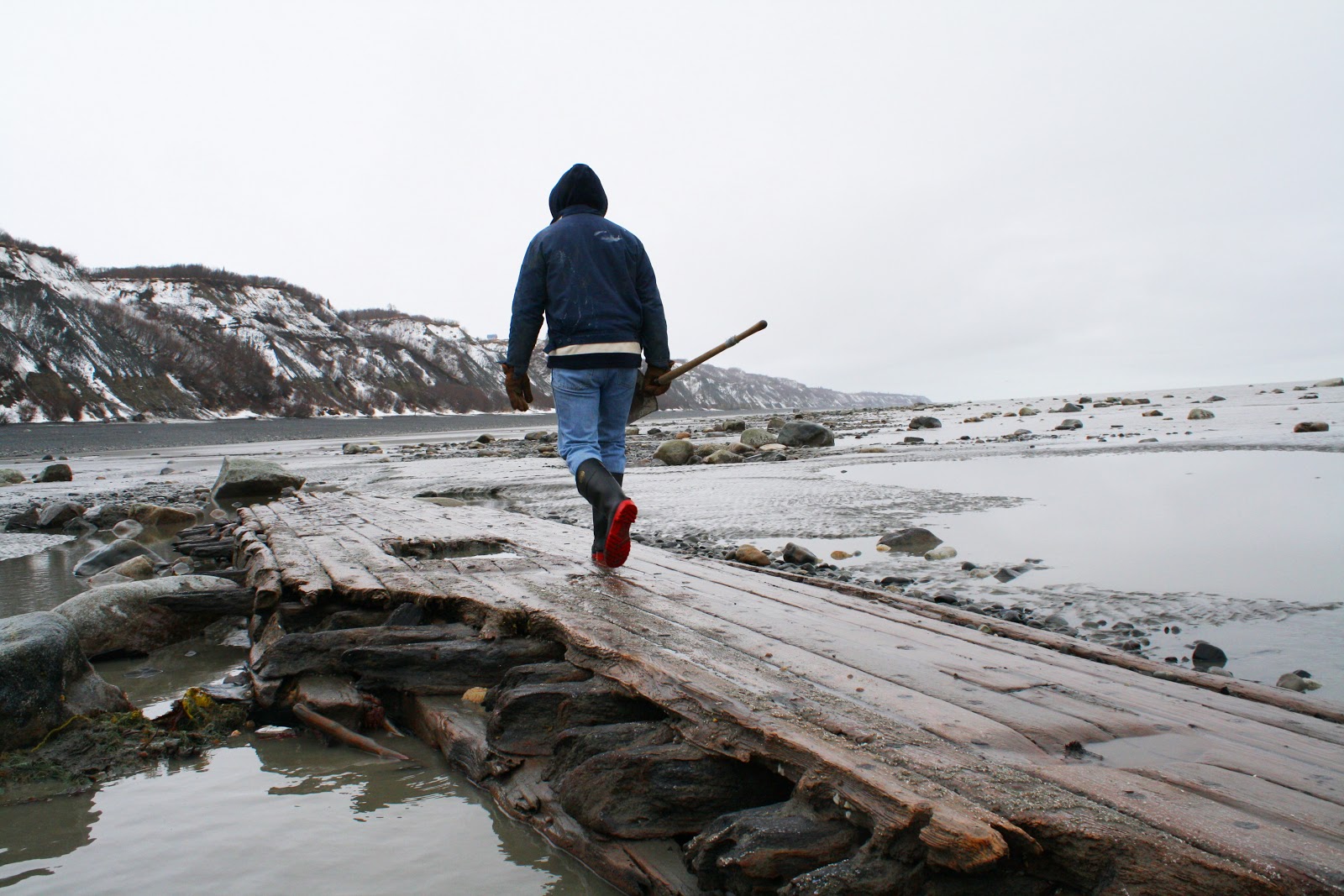
One of the last remaining pieces of the wreck of the Corea in 1890.


THAT WHICH WE CALL A ROSE….

April 2010

Our perception of what is historically important is often determined by the names we assign to the events or objects that reflect that history. A name acts like a marker, reminding us of the past. Consequently, when a name disappears, the associated history tends to follow. For example:

Mike Steik, who was born in Ninilchik in 1934, can remember an old marine navigation map that he once kept rolled up in his boat when he fished commercially in the early 1950s. On that map, just south of Corea Creek, lay a stretch of shoreline clearly labeled “Corea Bend.”

Since he stopped fishing after he was drafted into the military in 1956, Steik said he has lost track of that map, and he can’t remember seeing one since that featured the name “Corea Bend.”

Ninety-two-year-old Nick Leman, who was born in Ninilchik in 1917 and honeymooned with his wife, Marian, in a small cabin near Corea Bend in August 1947, said that that stretch of shoreline has been called Corea Bend as far back as he can remember. His 90-year-old brother, Joe Leman, concurs.
"Corea Bend" can be seen penciled into this old
map depicting east-side fish traps.


These days, real estate maps of the area nearby—just west of the Sterling Highway, at about Milepost 126—typically show a street called Corea Bend Road that curls along the southern edge of Corea Bend Subdivision. Some such maps may show and label tiny Corea Creek, but they will not show Corea Bend itself.

In his 1971 Dictionary of Alaska Place Names, Donald J. Orth offers a specific entry for Corea Creek—including its origin dating back to a 19th-century shipwreck in the area—but does not even mention Corea Bend.

And Alaska historian Robert N. DeArmond, who founded the Alaska Northwest Publishing Company, wrote in the 1970s that Corea Bend used to appear on local maps and charts but had been “unfortunately” omitted from more recent editions.

The reasons for this cartographical vanishing act are unclear. Perhaps Corea Bend owes its disappearance to its lack of geographical prominence, since it neither juts outward like Anchor Point nor sags inward like Chickaloon Bay. It is not even as clearly defined as the mile-long Corea Creek near its northern head.

In fact—since the bulk of the shipwreck was likely pillaged early on by scavengers and then pulverized more than a century ago by the forces of ice and tide—the creek is the only named physical reminder of an incident that shook up the fledgling Cook Inlet cannery world 120 summers ago.


The three-masted wooden bark Corea was built in Boston in 1868, and she began making supply and passenger runs from San Francisco to Cook Inlet in the spring of 1885. On her fateful final voyage, she departed the California port on March 27, 1890, and nearly a month later she was cruising up the inlet when disaster struck.

The Corea hard aground below Kalgin Island, 1890.
In “thick weather” at about 3 a.m. on April 23, and running against a strong outgoing tide, according to the official Wreck Report filed for the ship’s owner, the Arctic Fishing Company, she ran hard aground of a sandbar approximately six miles south of Kalgin Island. There, below a landmark that on an 1802 map had been named Isla de Peligro (or “Island of Danger”), her voyage halted as the tide continued to ebb, and within a few hours she sat high and dry.

An 1890 photograph (from the H. M. Wetherbee Collection) taken of the Corea early the following morning shows her sails at half-mast, her hull almost entirely on dry land, men on her deck, the seas calm, and a stack of her coal and some other materials in two separate piles alongside her keel.

This photo also clearly illustrates the impressive size of the vessel: 133.4 feet from bow to stern, 31.5 feet from port to starboard, and 18 feet deep. She weighed nearly 565 tons and had been carrying a cargo weighing about 500 tons—mostly coal and cannery tin and other cannery supplies—in addition to a 19-man crew and 97 passengers, 77 of whom were Chinese laborers bound for work at the Kasilof cannery, according to “Canneries of Kasilof and Kenai, 1889-1896,” a Wetherbee photographic display at Kenai Peninsula College.

After striking the sandbar, according to a May 1890 article in the Daily Alta California, “the crew and Chinese passengers were put to work at the pumps.” The ship’s master, Captain H.H. Wheeler, then waited for the tide to rise again and assessed the damage.

The Corea, beached on what became known as Corea Bend, 1890.
The Wreck Report states: “Got her off the reef and found the vessel was filling”—12 feet of water in the hold, according to a notation on the Wetherbee photograph—“so ran her 25 miles in sinking condition to East shore of Cook’s Inlet and beached her.”

Wetherbee photos of the second beaching site clearly show that the vessel rammed ashore at the mouth of what would become known as Corea Creek, about 15 miles south of the canneries on the Kasilof River. One of those photos also shows shipwrecked passengers and crew from the Corea encamped along the shoreline near the creek mouth.

At this camp, according to oral history collected by Bobbie Oskolkoff of Kenai, was Oskolkoff’s great-grandfather, Robert James Kelly, who at some point walked north with a group of the Chinese laborers to the Arctic Fishing Company cannery at the Kasilof River mouth.

Crew and passengers of the Corea, encamped on the east-side beach. Note
the break in the bluff in the background: That is the mouth of Corea Creek.
Although these men were likely seeking employment, it is unknown what they found. Because of the wreck, AFC did no canning in the summer of 1890. A second Kasilof cannery was built that same year by George W. Hume and, according to the KPC display, the Hume cannery became the primary operation in Cook Inlet that year because of the shipwreck of the Corea.

Articles in both the Daily Alta and the San Francisco Call from the summer of 1890 state that, after the beaching, nearly every movable item on the ship was brought ashore and saved, and parts of the ship were dismantled.

“A survey was held on the bark and resulted in her being condemned. She was afterwards sold as she lay for $355,” said the Daily Alta. The Call referred to the sale as an “auction” and said that both “the cargo and hull” were sold together.

According to two separate articles in the Daily Alta, most of the crew and passengers, all of whom survived, were eventually were rescued by another member of the AFC fleet, the steamer Francis Cutting, which hauled the men to Kodiak.

At some point in May, the steamer Bertha carried Captain Wheeler, Chief Mate Oliver, the second mate and two seamen from the Corea back to San Francisco. Some of the rest of the “crew and fishermen” from the Corea were returned to San Francisco later that summer aboard the schooner Glen.

Ultimately, as stated in the Wreck Report and attested to by AFC owner/manager F.P Kendall, insurance covered most of the losses—except those incurred by the cannery. The vessel had been valued at $15,000 and insured for $12,500, and its cargo had been valued at $45,000 and insured for $41,600.


Today, only one remnant of the Corea is still known to exist. Although it has been shoved south along the shoreline far from its original resting place, and can be seen only when the tides along Corea Bend are quite low, the approximately 80 feet of water-logged beams serve as a reminder of both the power of nature and the importance of this local historical event.

Someday, however, the wearing actions of tide and time may erode the last bits of the old wooden bark, the name of the tiny stream at the wreck site may fade from all maps and charts as did the stretch of beach, and the wreck of the Corea will become little more than an interesting factoid glimpsed by researchers studying the history of Cook Inlet fisheries.

Examining a big piece of the old wreck.
 

Tuesday, April 30, 2013

"First One to the Lake"

Early morning mist beyond Don Culver's dock on Longmere Lake, 1947. (All photos courtesy of the Culver family)

FIRST ONE TO THE LAKE

March 2011

Around Longmere Lake today, 102 individual parcels of land make contact with the waterline. The largest of these parcels is 27.06 acres. The smallest is a triangular sliver of only 0.07 acres.

In the spring of 1947, however, there was only a single private parcel of land—a 167.29-acre homestead along the northwest shoreline.

The lake today features an air taxi service, several bed-and-breakfast establishments and a lodge, in addition to the homes of dozens of families and individuals. As such, Longmere is a busy place, frenetic with activity. In the summer, as swimmers and canoeists ply the waters, the lake is abuzz with floatplanes and jet-skis; in the winter, ice-fishermen bore holes into the lake to jig for trout as snowmachines roar up and down its frozen length.

In the early summer of 1947, common loons were the most frequent breakers of the natural quiet, and a single white canvas tent was the only sign of civilization along the 1.5-mile stretch of fresh water that runs diagonally from northeast to southwest on a topographic map.

In 1947, the Alaska Road Commission had cleared a pioneer trail suitable for Caterpillars and other road-building equipment; this trail would one day be a permanent road (the Sterling Highway) from Cooper Landing to Kenai and Homer, with a junction near the mouth of Soldotna Creek, where homesteading land was just becoming available. The new road was slated to pass less than 500 feet from the lake’s northernmost tip.

The single man in the white canvas tent liked this situation. And even a nearly disastrous turn of events later that summer could not dissuade him.

*****

Don Culver may have been just 20 years old when he landed for the first time on Longmere Lake, but already his was a life rich with experience. His step-father had taught him to fly when Don was only 14 or 15. In February 1945, a month before his 18th birthday, he had enlisted in the U.S. Navy to assist the American effort in World War II. Because the war ended before that year was out, Culver found himself released from military duty in July 1946, when he was only 19. Back home in Palo Alto, California, he decided to head north to visit his biological father, Ben Culver, in Anchorage.

Ben, who had traveled to Alaska during the war as a field officer with the American Red Cross, was an Anchorage realtor with political leanings and plenty of connections. Ben had been to Alaska at an even earlier time to visit his brother, Walter Culver, who had been hired by the Bureau of Indian Affairs to come to Alaska in 1915 with his wife, Mildred, and teach Eskimo and Aleut children at Port Moller.

By the time Don arrived in Anchorage and found employment, Uncle Walter had already been through town—acting as a deputy game warden, a chief special agent for the Alaska Railroad, a U.S. deputy marshal, and the Anchorage chief of police—and had moved on, mining and prospecting in the Goodnews Bay area for a decade before retiring in California in 1943.

Ben, on the other hand, was fully immersed in the Anchorage scene. One day, when Don was visiting his father, he met an influential man whose information changed the course of his life. “(Dad) was having dinner with a friend of his who was named Hawley Sterling,” Don said. “He was the engineer for the section of road from Cooper’s Landing through to Homer, and at that time it had been engineered and had a Cat trail roughed out at least as far as Soldotna, and then hooking on to the old Kenai road.”

Hawley Sterling was the man for whom this stretch of highway (as well as the community just east of Soldotna) would one day be named. During that particular dinner conversation, however, Culver knew him simply as man with an intriguing document.

“Hawley told my dad that while he was in the process of surveying, he said he had camped on this lake, and that if he wasn’t involved in something else, it was a place he’d love to settle. So that made me think, ‘Oh, man, that’s pretty good,’ and he had a survey map, and he gave us a copy of it. And it showed this lake…. Well, officially the survey had not been published as such, but he had the information and the location, and I had a fresh pilot’s license.”

So in mid-March 1947, Don and Ben Culver paid a visit to Jack Carr’s Flying Service at Merrill Field and rented a single-engine airplane affixed with snow-skis. They flew south and located the lake about five air miles west of the wooden bridge over the Moose River near its confluence with the Kenai River. After viewing from the air the snowy survey lines, they landed on the frozen lake surface and used the survey map to locate corner posts and stake out a homestead claim.

Map in hand, they were able to stake almost exactly 160 acres, despite the curving shoreline of the lake. Then, in the tradition of many claim-stakers before them, they located a section corner and made Don’s claim official. “We did the old miners’ thing of taking a Prince Albert tobacco can and nailing it to a tree. We put my claim in there and made a copy of it and went back to Anchorage to the District Land Office and filed it with the clerk.”

The romanticized name for the lake was Ben Culver’s contribution: “Because of its shape—a long lake—and because he had some old Scottish history—‘mere’ being an Old English word for water or pond or lake—‘Longmere’ came out of that.”

In early May, Don chartered Bill Cuffel’s Waco floatplane to haul himself and his gear down to his homestead, and he established a camp just north of the first point of land protruding into the lake from the western shore. He erected an 8x10-foot white canvas wall tent and constructed a log cache designed to keep his foodstuffs eight feet off the ground and away from hungry bears. Inside his tent, he placed a “little bitty cookstove,” a cot and his tools.

As soon as he had settled in, he selected a cabin site just south of the same point of land and began clearing trees and preparing to build. He had decided to use the materials most readily available, and from a mostly deciduous patch of trees he selected aspen logs for the foundation and walls of his new home. Two of the four corner posts on which his cabin would rest were stumps left behind by his clearing process.

The aspens for the first four or five horizontal courses of the cabin he cut in the spring when the sap was running thick under the bark; as a result, these logs—as can be seen clearly in early photographs of the cabin—darkened substantially more than those he cut later in the summer.

Start of the Culver cabin, constructed mainly of peeled aspen logs.
By the end of June, Culver had laid in about three courses of those early logs, and he had ordered materials he would need as the cabin construction progressed, including framed glass windows, eight-inch shiplap for the cabin floor and roof, aluminum roofing, and a stovepipe. During that dry June, however, a spark kindled near Hidden Lake (almost 20 miles to the east) broke out into a conflagration that threatened Culver’s construction venture and his peaceful new existence.

By late July, the 1947 Kenai Burn had blackened nearly 300,000 acres of the central peninsula lowlands. The forest fire moved relentlessly westward, and during this month Culver found it necessary to take action.

“The Army sent a team of people down to supposedly protect stuff and try to see what they could do if the fire headed toward Kenai,” Culver said. “They came through and invited me to join them. They sort of considered me as a local scout , so I took all my camp and buried the stuff—made a pit and covered it over so it wouldn’t burn, and I put foodstuffs and other things up on the cache—and then I went and joined them for about 10 days.”

During those 10 days, the massive fire at last began to die. When Culver returned to his homestead, he discovered that that he had been lucky: The blaze had barely encroached on the eastern edge of his property before dissipating.

Culver quickly settled back into a work routine. He began laying new horizontal courses of aspen logs, while preparing to set the shorter vertical logs that would form the stockade-style upper half of each wall. By hand, he felled each tree, cut it into lengths and then stripped it of its bark; he fitted logs together, notching where necessary, planning carefully.

The back wall, which faced east toward the lake, would feature two framed windows that he had ordered from Anchorage. He planned to install a third window next to the door in the front of the cabin, and a fourth in the south wall, facing down the lake.

As Culver worked, he was blithely unaware that he was about to have company for the very first time.


Don enjoys a roaring campfire at the lake in 1947.


*****

Two hardy individuals, both natives of Chicago, were trudging westward out of the mountains and across the flats—as unaware of Culver’s existence as he was of theirs. They were on their way toward Soldotna Creek, where they planned to stake a homestead of their own.

Frank and Marge Mullen had flown in 1945 from Chicago to Anchorage in Frank’s three-place, single-engine Stinson 105. In Anchorage, they had worked and lived until homestead land became available on the peninsula, at which point they had flown over the available areas and picked out the spot they liked.

In August 1947, the two city slickers rode the train out of Anchorage to Moose Pass, hitched a ride along a jeep trail to a point just west of Tern Lake, and then donned their heavy, uncomfortable backpacks and began to walk the Cat trail.

After leaving behind Henton’s Lodge in Cooper Landing, they saw no one until they reached the Alaska Road Commission camp at Hidden Lake. In camp, ARC boss Ralph Soberg was a congenial host and asked them what their intentions were. “We told him we were going down there to be farmers,” Marge Mullen recalled. “’Oh, no,’ he says. ‘Go down there and build a roadhouse—have a bar. That’s the way you make money.’ I didn’t show any reaction to him, I hope. I had two little babies at that time. I wasn’t going to be a barmaid.”

Marge shrugged back into her Trapper Nelson, and the couple moved on. After spending the night in their mosquito tent at Skilak Lake, where “it rained like Billy Be Damned,” they wrung out their sopping sleeping bags and continued on down the road. They traveled through a smoldering landscape and had no human encounter until just before the wooden bridge across Moose River, where they visited the new homesteads of Aletha and John McFarland and Lucy and Edgar Law.

The Mullens crossed the bridge and camped along the west bank of the river. Then the next day, five miles further west, they approached Longmere Lake.

“Somehow Frank saw this really small notice on a tree—not any more than a piece of paper, a paper that gave a physical description of the land, and it was signed ‘Don Culver’ and said, ‘Come in and see me,’” Mullen said. “So then we found his little foot trail and went down there. It was a really sunny, beautiful night, and we just stayed the one night with him and talked a lot about what he was doing and what we planned to do.”

Culver treated his new acquaintances to a meal—“probably beans,” he said, although Mullen suspected it may have been Army rations—and he offered them what little accommodations he had.

The Mullens spent the night in Culver’s tent, and in the morning trundled back out to the Cat trail to walk the remaining five miles to Soldotna Creek and the junction of the main highway corridor with its spur road to Kenai. Despite the brevity of their first time together, Culver and the Mullens became close friends and remained as such.

When Culver later came into Soldotna for supplies or just human companionship—sometimes as often as once a week—he stayed with the Mullens. And when he married Dolores “Dee” Mulqueen in Anchorage in 1950, the Mullens were in attendance.

The newlywed Culvers and their friends, the Mullens, 1950.
While Marge has continued to live in the same spot for more than 60 years, Culver’s later career with Alaska Airlines—seven years as a mechanic, then 30 more as a pilot—moved him frequently away from the lake and then finally away from the state entirely. Still, Culver and Mullen have never lost touch; in fact, Culver, now 84, flew up last summer for Mullen’s 90th birthday party.

After the Mullens departed, Culver resumed his labor. As autumn approached, he completed the walls of his cabin—working solo except on the rare occasions that his father and step-mother flew in for a visit. Atop the vertical aspen logs, he switched to peeled spruce, which he used to create the ridgepole, rafters and purlins that framed the roof. The ends of each gable he also fashioned from spruce that he laid in horizontally.

With winter approaching, Culver needed to bring in from Kenai the flooring and roofing materials that he had ordered. Unfortunately, due the primitive road conditions, the Kenai building supply company could bring the materials no farther than Soldotna, so Culver borrowed a tractor, skidded the items out to his foot trail, and then hand-carried them the rest of the way to his cabin site.

*****

At some point that fall, his construction project was interrupted by the sound of a small airplane circling briefly and then landing with floats on the lake. Inside the plane were four men: the pilot Bill Cuffel and three friends planning to homestead on the lake—Lyle Edgington, Bob Murray, and Carl Weber.

According to Edgington, each of the friends staked out a section of land, visited briefly with Culver and helped him install his roof, and then flew back to Anchorage to file their claims. They said they planned to return the following spring to build cabins on the lake.

Culver was about to have neighbors.

By the time the snow began to fly, he had completely enclosed his cabin but had done none of the chinking necessary to keep the place warm; consequently, he moved his canvas tent indoors and set up camp there, out of the weather, while he did some finish work.

On Nov. 1, Edgington, Murray and Weber—along with a German short-haired pointer that had been given to them by a Yellow Cab driver in Anchorage—showed up at the lake again. They announced that they had changed their plans, deciding to build right away so that they would be free to work throughout the summer. They pitched a canvas tent in the snow over on Edgington’s homestead, built rough beds out of spruce logs and boughs, installed a small wood-burning cookstove inside, and then began cutting and processing logs for a cabin of their own.

Just before Thanksgiving, Culver—needing a paying job in order to keep himself in groceries and finance the continuation of his homesteading project—returned to Anchorage on a plane sent by his father.

He left the trio of friends to their own devices.

*****

In 2011, the drive from the eastern edge of Cooper Landing to Longmere Lake is somewhat less than 45 miles on a firm bed of two-lane, lined blacktop. Despite the reduced-speed areas through Cooper Landing and Sterling, it is not uncommon for a driver to make this journey in an hour or less.

Consequently, it may be difficult for modern drivers to comprehend how it managed to take 21-year-old Don Culver five days to drive that distance in the spring of 1948.

“I went down as soon as the road was clear,” Culver said. “I had bought a (military) surplus truck and barged it across from Anchorage over to the little town of Hope and then down the old forest road from there to Henton’s Lodge. I could get as far as Cooper’s Landing on the forest road, and that’s where the new road was to start. It was just a Cat trail then, but I had a 4x4 weapons carrier and all my gear for the year, a couple, three drums of fuel, and things like that.”


Don's truck parked on Sterling Highway.


And thus loaded down in breakup conditions, the truck sank easily in the soft, exposed soil.

“I required two or three assists from Road Commission tractors that were working in the neighborhood to get me out of mudholes, or (had to do it) myself by digging and then corduroying through and around swamps and things,” he said. “I would go and get stuck and have to dig out, and cut wood to fill the holes and make a little corduroy patch to get on to the next place with the four-wheel drive. It did not have a winch, but it was a pretty good rig to drive around.”

Virtually every bog or mudhole required either assistance or hours of toil and sweat, and the bogs and mudholes were plentiful. Eventually, however, Culver arrived at the lake. When he had begun his building project, he had been the first and the only owner of private property on the lake. Now he was one of three.

*****

Edgington, Murray and Weber had built a rough cabin with logs cut from trees on the property and made the floor and roof with lumber trucked overland from Seward. It had been cold enough during the construction process that they kept a fire burning nearby throughout the day, and their dog had sat constantly by the fire while the men worked. At night in the tent, they had wrapped the animal in a big Army overcoat to keep it warm.

They hadn’t been working long, however, when Weber decided to give up on homesteading and headed to Seward to become a longshoreman.

“Weber, he couldn’t get along with Bob Murray,” Edgington said. “I could see his point, too. He (Murray) was a screwball son of a bitch as far as I was concerned. I had to keep them apart most of the time. They were always arguing and quarreling.”

By early January 1948, Edgington and Murray had constructed a livable structure with a small woodstove, and they struggled against the elements as the coldest part of winter set in. Shortly after Culver returned that spring, both men went to work for the summer—Murray at the Libby McNeil & Libby cannery on the lower Kenai River, and Edgington back to Anchorage to see what he could find. Both returned to their homesteads whenever they were able.

Meanwhile, Culver continued to work on his land. He cleared and sowed about two acres to meet homesteading standards. He finished chinking his cabin walls and made the place livable. He cut and split and stacked cords of firewood. He built a dock down at the lake.

Finished cabin at Longmere Lake, 1948.
He also walked or drove his truck into Soldotna nearly every week, visiting and staying with the Mullens. Often, he said, he would fish for salmon in the Soldotna area, but occasionally he would walk the length of Longmere Lake and travel through the woods south to the middle river to wet his line. On one such excursion, he returned to his cabin to discover that a well-known boozer from Kenai had stopped by his place, consumed some of his food and divested Culver of his small supply of alcohol.

“He left me a note that he’d had supper and drank my brandy—I had a small bottle there to have on hand and wasn’t drinking it at all—but he drank that all up and left a note saying he’d come back one day and replace it, and of course he never did.”

Generally, however, life on the lake was sedate and seldom interrupted. When winter arrived, Culver packed up and returned to Anchorage once more, working at Merrill Field sometimes, and other times for the ARC. That same year, Culver began his relationship with “Dee” Mulqueen, and in 1950 they married in the Catholic church in downtown Anchorage.

Around this same time, Culver began a new job as a mechanic for Alaska Airlines, and his subsequent transfer to Bethel for the next two years took him away from Longmere and his peninsula friends for most of each year.

Dee and Don Culver and two of their
kids at the lake cabin, 1952.
In 1953, Culver began doing his mechanical work out of Anchorage International Airport, and he was building steadily toward a commercial pilot’s license. Often, particularly in the summer months, Dee and their children would stay in the Longmere cabin, and Don would join them on the weekends. The kids—the Culvers would eventually have one son and four daughters—loved the time on the homestead, fishing, boating, swimming, playing, gathering water, listening to the loons, and watching what their father called “sea smoke” form over the water.

At times, Culver, who still sings every Sunday in his church choir in Seattle, would fill the cabin with music. “I can remember as a little kid at the cabin, he’d play the harmonica and just kind of quietly sing along,” said Terri Culver, the eldest daughter. Even now, she said, hearing him sing transports her back across the years. “It makes you a little kid again, definitely just makes you sit back and remember home.”

In 1956, Culver achieved his dream job as a commercial pilot, flying DC-3’s for Alaska Airlines out of Anchorage, but by the end of 1957 he was faced with a difficult choice: transfer to Seattle and remain a pilot, or stay in Alaska and look for another job. In 1958, the Culvers moved to Washington, where Don would conclude a 37-year career with the airlines with his retirement in 1987.

Of the Culver children, only the oldest, Marc, still lives in Alaska. The daughters live in Washington and California. Dee passed away in 2005, and Don lives on a sailboat and spends most of his spare time restoring old aircraft.

The Culvers had surveyed their lake property into sections and sold the first piece in about 1980, holding onto the final piece until 1998. Even all the way from Washington, Culver said, he felt some pain in letting go.

“It’s just circumstances and family needs and choices that took me right from it,” Culver said. “I wish I had it still. I just have great, fond memories of it. That’s where I enjoyed visiting. And having a bit of Alaska reminded me of where my adult life started.”

Before Culver sold the cabin property, the cabin itself was used periodically by squatters and sometimes, by arrangement, by Boy Scouts or campers from the Catholic church. Over the course of time, it began to become run-down and ramshackle. Today, a new house sits where the cabin once stood. After he sold homesite, the new owners bulldozed the old cabin and started fresh.

When he visited Longmere about 10 years ago, he said he felt “amazement” at the growth he saw. “People had built nice houses and roads, and I had my name on one of them, and I felt a little bit of pride in having started that and having been one of the early folks in the country. But also there was the realization that I wished I hadn’t sold it all. So that combined a little sadness with not being a part of it anymore.
“But having achieved several years in my life, well, you’ve got to be philosophical about some stuff, and you make choices and you live with them.”

The loons still visit Longmere Lake each summer, but they’ve got a lot more company these days.
Culver visits the lake in 2000 and is amazed at the progress.